Why this page exists
Technology for new construction in the Panther Creek and Cochran's Crossing villages sits where two things meet: how new construction actually operate, and what the Panther Creek and Cochran's Crossing villages specifically brings to the building. 77381 covers original Woodlands villages like Panther Creek and Cochran's Crossing, defined by heavy preserved forest canopy and tree-protection covenants.
Low voltage is scheduled against a construction programme it does not control. Delays upstream compress the window; a compressed window means either additional mobilisations or work done under pressure. Being ready in advance — decisions made, materials on site, pathway plan settled — is the main defence.
Working inside somebody else's schedule
Low voltage is scheduled against a construction programme it does not control. Delays upstream compress the window; a compressed window means either additional mobilisations or work done under pressure. Being ready in advance — decisions made, materials on site, pathway plan settled — is the main defence.
The gap between rough-in and finish is its own risk. Cable sitting in walls for months needs protecting and identifying clearly, or the finish crew spends the first day working out which coil goes where. Documenting as-built positions before the walls close is what makes the return visit efficient.
- Readiness before the window opens, since it will not extend
- Additional mobilisations where the schedule fragments
- Cable protected and clearly identified during the gap
- As-built documentation completed before walls close
- Coordination with electrical, mechanical, and fire-protection trades on pathway
the Panther Creek and Cochran's Crossing villages: what the location adds
The starting point for any the Panther Creek and Cochran's Crossing villages job is one local fact. 77381 covers original Woodlands villages like Panther Creek and Cochran's Crossing, defined by heavy preserved forest canopy and tree-protection covenants. That single condition shapes where cable can run, where equipment can sit, and how coverage is laid out — more than any spec sheet does. Two more conditions weigh on it. Dense mature trees strongly favor wired backbones and mesh over line-of-sight wireless and heavily shade exterior camera views. 1980s-1990s homes here predate structured wiring, making retrofits the norm. Together they make the route specific to this pocket, which is why a short walkthrough or a few clear photos settle the scope faster than a floor plan can.
- 77381 covers original Woodlands villages like Panther Creek and Cochran's Crossing, defined by heavy preserved forest canopy and tree-protection covenants
- Dense mature trees strongly favor wired backbones and mesh over line-of-sight wireless and heavily shade exterior camera views
- 1980s-1990s homes here predate structured wiring, making retrofits the norm
- Tree-preservation rules and architectural covenants govern exterior equipment placement and any trenching
- Wooded, deep lots put distance between the house, driveway, and street for camera and gate runs
One window, and it does not reopen
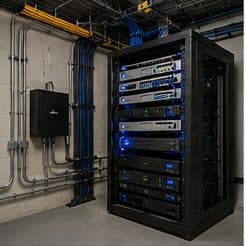
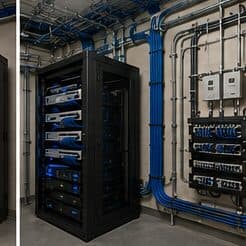
Low-voltage rough-in happens in a specific slot: after framing and electrical, before insulation and drywall. Inside that window, running a cable anywhere is straightforward. Once drywall goes up, the same cable costs many times more and sometimes cannot be run at all.
The asymmetry is the whole story of new-construction low voltage. Decisions made cheaply during rough-in become expensive or impossible afterwards, which is why the pre-rough-in planning conversation is worth more than any equipment choice made later.
- Rough-in window sits between electrical and drywall
- Upstream delays compress the window without extending the deadline
- Post-drywall changes cost many times more, if they are possible at all
- Finish work happens months later, after paint and ceilings
Installing in the Panther Creek and Cochran's Crossing villages
Three things matter more than everything else combined: agreeing device locations before rough-in, claiming pathway before the other trades fill the ceiling, and running more capacity than the current plan requires.
Getting the Panther Creek and Cochran's Crossing villages work done means planning around the site as it actually is. Tree-preservation rules and architectural covenants govern exterior equipment placement and any trenching. Wooded, deep lots put distance between the house, driveway, and street for camera and gate runs. Both matter as much as the design to how and when the work happens. The scope is drawn from the real property, the coverage is stated as a service area rather than an office, and unverifiable specifics about the Panther Creek and Cochran's Crossing villages are kept off the page on purpose.
Popular services nearby
Frequently searched near this area — the pages people look for most.
Frequently asked questions
What do new construction in the Panther Creek and Cochran's Crossing villages usually need first?
It varies by site, but the pattern for new construction holds in the Panther Creek and Cochran's Crossing villages: get the network and cabling backbone right, then layer cameras and access on top. What the Panther Creek and Cochran's Crossing villages changes is the physical install — the conditions listed above drive routes and equipment placement more than the sector alone does.
What has to be decided before rough-in?
Device locations, the equipment room position, and the pathway plan. Equipment selection can wait — you can run cable to a position without knowing which camera or access point will go there. What cannot wait is the decision about where things go, because that is what determines where cable is pulled while the walls are open.