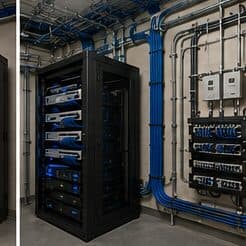
Video wall installation for new construction, in Stafford
Video wall installation for new construction in Stafford is a three-part question: what video wall installation involves, what new construction need from it, and what Stafford changes about the install. Commercial base weighted toward warehouse, showroom, and light-industrial buildings rather than office space.
Get any of that wrong and it stops reading as one display: panels misaligned so lines step across the seams, colour mismatched between panels, content that does not account for the mullions, or a wall built so tightly that servicing one panel means dismantling the array.
One window, and it does not reopen
Low-voltage rough-in happens in a specific slot: after framing and electrical, before insulation and drywall. Inside that window, running a cable anywhere is straightforward. Once drywall goes up, the same cable costs many times more and sometimes cannot be run at all.
The asymmetry is the whole story of new-construction low voltage. Decisions made cheaply during rough-in become expensive or impossible afterwards, which is why the pre-rough-in planning conversation is worth more than any equipment choice made later.
- Rough-in window sits between electrical and drywall
- Upstream delays compress the window without extending the deadline
- Post-drywall changes cost many times more, if they are possible at all
- Finish work happens months later, after paint and ceilings
What changes video wall installation from job to job
Scope depends on array size, panel grade, and content.
- Array size and panel count
- Panel grade and bezel width
- Processor and source requirements
- Wall structure and flatness
- Content complexity and spanning needs
- Service-access and mounting type
Stafford: what the location changes
What separates a Stafford scope from the rest of the city is concrete and local. Commercial base weighted toward warehouse, showroom, and light-industrial buildings rather than office space. Metal building construction that reflects wireless signal and changes coverage behaviour compared with drywall interiors. Building footprints frequently exceeding the 100 m copper channel limit from a single equipment position. That short list is what actually drives the design in this pocket, and it is why photographs or a brief site visit beat a floor plan — the plan follows the building's real constraints, not the neighborhood name on the map.
- Commercial base weighted toward warehouse, showroom, and light-industrial buildings rather than office space
- Metal building construction that reflects wireless signal and changes coverage behaviour compared with drywall interiors
- Building footprints frequently exceeding the 100 m copper channel limit from a single equipment position
- Largely unconditioned operational areas where equipment placement has to account for summer temperatures and dust
- Mixed occupancy within single buildings, with small conditioned office areas attached to large operational space
Getting it done in Stafford
A video wall is commissioned as one display, panel by panel.
Full system design is often not finished when the rough-in window arrives. That is normal, and it is not a reason to skip the pathway. Running conduit or sleeves to likely positions preserves the option cheaply even when the eventual equipment is undecided.
Getting Stafford work done means planning around the site as it actually is. Largely unconditioned operational areas where equipment placement has to account for summer temperatures and dust. Mixed occupancy within single buildings, with small conditioned office areas attached to large operational space. Both matter as much as the design to how and when the work happens. The scope is drawn from the real property, the coverage is stated as a service area rather than an office, and unverifiable specifics about Stafford are kept off the page on purpose.
Frequently asked questions
Is video wall installation for new construction different in Stafford?
The sector needs stay the same, but the install changes with the place. In Stafford, the conditions above — not the new construction label — decide routes, mounting, and equipment placement, which is why this page pairs all three.
How is a video wall different from mounting several TVs?
Precision and the system behind it. A video wall's panels must be co-planar and aligned to a fraction of a millimetre so seams read as continuous, driven by a processor that splits and scales content and compensates for the gaps, and built so one panel can be serviced without dismantling the array. Hanging several TVs is nowhere near that tolerance — treat a wall that way and it looks like separate screens.