Why this page exists
Paging & PA systems for new construction is shaped by how the space is used, not just by the service itself. New construction bring their own operating constraints, and this page pairs what paging & pa systems actually involves with what that environment changes about it.
A paging or PA system carries announcements across a space so they are heard clearly wherever people are — an office, a warehouse floor, a school, a retail back-of-house. The work is coverage and clarity: enough distributed speakers that a page is intelligible everywhere rather than blasting near one horn and inaudible elsewhere, sensible zones so a page can go to the right area, and priority so a page overrides background music rather than fighting it.
One window, and it does not reopen
Low-voltage rough-in happens in a specific slot: after framing and electrical, before insulation and drywall. Inside that window, running a cable anywhere is straightforward. Once drywall goes up, the same cable costs many times more and sometimes cannot be run at all.
The asymmetry is the whole story of new-construction low voltage. Decisions made cheaply during rough-in become expensive or impossible afterwards, which is why the pre-rough-in planning conversation is worth more than any equipment choice made later.
- Rough-in window sits between electrical and drywall
- Upstream delays compress the window without extending the deadline
- Post-drywall changes cost many times more, if they are possible at all
- Finish work happens months later, after paint and ceilings
What paging & pa systems usually involves
The clarity problem is the common one: one loud speaker or horn is deafening up close and unintelligible across the room, and in a noisy warehouse an office-grade ceiling speaker cannot cut through. Coverage comes from distributed speakers at a sensible density for the ceiling height and the noise level, with horn speakers where the environment is loud.
The second is control: without zones, every page goes everywhere, and without priority, a page competes with background music instead of overriding it. Zones let a page target an area, and page-over-music priority ducks or interrupts the music so the announcement is heard.
- One loud speaker or horn instead of distributed coverage
- Office speakers that cannot cut through warehouse noise
- No zones, so every page goes to the whole site
- No priority, so pages fight the background music
- Speaker density too low for the ceiling height
- No phone-system integration, so paging needs its own station
What to rough in even without a final design
Full system design is often not finished when the rough-in window arrives. That is normal, and it is not a reason to skip the pathway. Running conduit or sleeves to likely positions preserves the option cheaply even when the eventual equipment is undecided.
For a commercial building, the reliable rough-in set is: cable to every likely device outlet, ceiling positions for access points spaced for the intended coverage, camera positions at entries and approaches, door positions with cable to the controller location, and pathway to any likely display or AV position. Plus, in every case, a properly located equipment room.
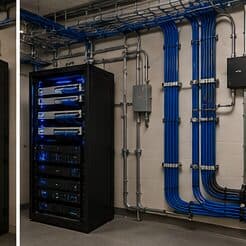
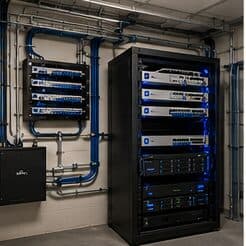
The equipment room deserves particular emphasis because it is the most commonly under-provisioned item. It has to hold the network rack, camera recorder, access-control panel, and any AV equipment, with dedicated power, ventilation, and clearance to work. Sizing it from the network alone is a decision that gets discovered eighteen months later.
- Sleeves and conduit to likely positions even before final design
- Ceiling access-point positions spaced for the intended coverage
- Camera positions at entries, approaches, and service areas
- Cable from every controlled door to the controller position
- Equipment room with dedicated power, ventilation, and working clearance
Distributed 70V speakers, zones, priority, and integration
Paging is built on constant-voltage (70V/100V) distribution, which lets many speakers share one amplifier over long runs with simple tap settings for level — the practical way to cover a large space evenly. Speaker density follows the ceiling height and the ambient noise: closer spacing and higher taps in noisy or high-ceiling areas, horn speakers where a warehouse or exterior demands projection, ceiling speakers where an office wants discreet even coverage.
- Constant-voltage (70V) distributed speakers for even, large-area coverage
- Speaker type and density matched to ceiling height and noise
- Horn speakers for noisy or exterior areas; ceiling for offices
- Zones so a page targets the right area
- Page-over-music priority that ducks or overrides background audio
- Integration with the phone system for paging from any handset
Frequently asked questions
What changes about paging & pa systems in new construction?
The operating environment does. New construction bring specific constraints — how the space is used, when work can happen, and what has to keep running — and those shape the paging & pa systems plan as much as the service's own technical requirements.
Why can't we just use one loud speaker to page?
Because it is deafening up close and unintelligible across the room. Paging works through distributed speakers at a sensible density so the announcement is clear everywhere at a comfortable level. In a noisy warehouse that means horn speakers with the projection to cut through; in an office, discreet ceiling speakers spread for even coverage.
What has to be decided before rough-in?
Device locations, the equipment room position, and the pathway plan. Equipment selection can wait — you can run cable to a position without knowing which camera or access point will go there. What cannot wait is the decision about where things go, because that is what determines where cable is pulled while the walls are open.