Home theater installation for new construction, in Kingwood
Home theater installation for new construction in Kingwood is a three-part question: what home theater installation involves, what new construction need from it, and what Kingwood changes about the install. Mature tree cover on wooded residential lots, attenuating outdoor wireless and generating camera motion events.
The room itself is the other half. Hard parallel surfaces create reflections and standing waves that smear dialogue and make bass uneven from seat to seat. Some soft surface, sensible subwoofer placement, and speakers aimed at the seating do more for intelligibility than any electronics upgrade.
Positions to prewire even if cameras come later
Camera positions are among the cheapest things to prewire and among the most annoying to retrofit, because they are usually exterior, high, and behind finished soffit. Running cable to likely positions during rough-in preserves the option at almost no cost.
The positions worth prewiring in nearly every building: primary entrance, rear or service entrance, any delivery or receiving point, parking approaches, and the equipment room itself. In residential construction, add the front door for a doorbell and the driveway approach.
- Primary and secondary entrance positions
- Delivery, receiving, and service door approaches
- Parking and vehicle approach positions
- Doorbell position in residential builds
- Cable terminated and labeled even where no camera is installed yet
What drives the cost of home theater installation here
Placement and cabling drive a theater more than the electronics do.
- Room type and the speaker count the format requires
- In-wall/in-ceiling versus freestanding speakers
- Cable routing, especially post-construction
- Acoustic treatment
- Display or projector and screen
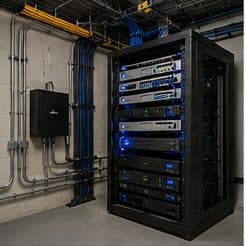
- Equipment rack, ventilation, and control system
Kingwood: what the location changes
The starting point for any Kingwood job is one local fact. Mature tree cover on wooded residential lots, attenuating outdoor wireless and generating camera motion events. That single condition shapes where cable can run, where equipment can sit, and how coverage is laid out — more than any spec sheet does. Two more conditions weigh on it. Larger lots with detached garages, workshops, and pool structures needing their own connectivity. Predominantly newer slab-foundation homes with good attic access. Together they make the route specific to this pocket, which is why a short walkthrough or a few clear photos settle the scope faster than a floor plan can.
- Mature tree cover on wooded residential lots, attenuating outdoor wireless and generating camera motion events
- Larger lots with detached garages, workshops, and pool structures needing their own connectivity
- Predominantly newer slab-foundation homes with good attic access
- Multi-storey floor plans benefiting from a wired access point per floor
- Seasonal foliage variation affecting any wireless link between structures
Getting it done in Kingwood
A theater is commissioned by listening from the seats, with measurement to back up placement.
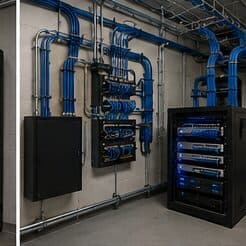
Low-voltage rough-in happens in a specific slot: after framing and electrical, before insulation and drywall. Inside that window, running a cable anywhere is straightforward. Once drywall goes up, the same cable costs many times more and sometimes cannot be run at all.
Getting Kingwood work done means planning around the site as it actually is. Multi-storey floor plans benefiting from a wired access point per floor. Seasonal foliage variation affecting any wireless link between structures. Both matter as much as the design to how and when the work happens. The scope is drawn from the real property, the coverage is stated as a service area rather than an office, and unverifiable specifics about Kingwood are kept off the page on purpose.
Popular services nearby
Frequently searched near this area — the pages people look for most.
Frequently asked questions
Is home theater installation for new construction different in Kingwood?
The sector needs stay the same, but the install changes with the place. In Kingwood, the conditions above — not the new construction label — decide routes, mounting, and equipment placement, which is why this page pairs all three.
Why is dialogue hard to hear but explosions too loud?
Usually the centre channel and the room. Dialogue lives in the centre speaker, and if it is poorly placed or the room smears it through reflection, speech gets buried while wide effects stay loud. Correcting centre placement, setting levels relative to the seat, and adding some absorption fixes far more of this than adjusting the volume ever will.