Gate & license-plate cameras for new construction, in Katy
Gate & license-plate cameras for new construction in Katy is a three-part question: what gate & license-plate cameras involves, what new construction need from it, and what Katy changes about the install. Housing stock skewed toward newer, larger single-family construction with wide floor plans that exceed single-router coverage.
Watching a gate or driveway and reading the license plates that come through it are two different objectives, and they usually need two different cameras. An overview camera shows the scene — who arrived, what happened — with a wide, well-lit view. A license-plate camera is tuned narrowly for one thing: a fast shutter to freeze a moving plate, a tight field of view and angle aimed at where plates appear, and controlled infrared so the reflective plate is legible at night rather than blown out.
One window, and it does not reopen
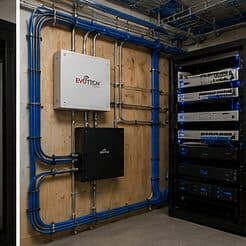
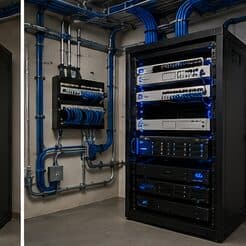
Low-voltage rough-in happens in a specific slot: after framing and electrical, before insulation and drywall. Inside that window, running a cable anywhere is straightforward. Once drywall goes up, the same cable costs many times more and sometimes cannot be run at all.
The asymmetry is the whole story of new-construction low voltage. Decisions made cheaply during rough-in become expensive or impossible afterwards, which is why the pre-rough-in planning conversation is worth more than any equipment choice made later.
- Rough-in window sits between electrical and drywall
- Upstream delays compress the window without extending the deadline
- Post-drywall changes cost many times more, if they are possible at all
- Finish work happens months later, after paint and ceilings
Where gate & license-plate cameras goes wrong — and how it's avoided
Entry camera systems fail when one camera is asked to do two jobs.
- Expecting one camera to both show the scene and read plates
- A slow shutter smearing plates on moving vehicles
- Uncontrolled infrared blowing out the reflective plate
- Field of view too wide to resolve a plate
- Stretching copper to a gate beyond its reach
- Skipping the overview camera and losing context
Katy: what the location changes
In Katy, the plan is built outward from the conditions that are actually here. Housing stock skewed toward newer, larger single-family construction with wide floor plans that exceed single-router coverage. Structured media panels commonly present but frequently located in a garage or perimeter utility space rather than centrally. Builder-installed cable often terminated to a panel but not extended to ceiling positions suitable for access points. Each one changes where cable can run, where equipment can sit, and how coverage is shaped, which is why a walkthrough settles a Katy scope faster than any generic estimate.
- Housing stock skewed toward newer, larger single-family construction with wide floor plans that exceed single-router coverage
- Structured media panels commonly present but frequently located in a garage or perimeter utility space rather than centrally
- Builder-installed cable often terminated to a panel but not extended to ceiling positions suitable for access points
- Slab foundations with accessible attics, making attic-to-interior-wall routing the standard retrofit path
- Suburban commercial development in retail pads and medical suites with suspended-grid ceilings and comparatively straightforward pathway
Getting it done in Katy
Entry cameras are verified against their objectives, day and night.
Full system design is often not finished when the rough-in window arrives. That is normal, and it is not a reason to skip the pathway. Running conduit or sleeves to likely positions preserves the option cheaply even when the eventual equipment is undecided.
On site, the schedule and working method turn on conditions like these. Slab foundations with accessible attics, making attic-to-interior-wall routing the standard retrofit path. Suburban commercial development in retail pads and medical suites with suspended-grid ceilings and comparatively straightforward pathway. Both shape how and when a crew can actually operate, which is why EVOTECH scopes each Katy job from the property itself rather than assuming one approach fits every address. Coverage is stated as a service area, never an office claim, and anything about Katy that cannot be verified is left out instead of invented.
Frequently asked questions
Is gate & license-plate cameras for new construction different in Katy?
The sector needs stay the same, but the install changes with the place. In Katy, the conditions above — not the new construction label — decide routes, mounting, and equipment placement, which is why this page pairs all three.
Can one camera watch the gate and read plates?
Rarely well. Reading a plate needs a fast shutter, a narrow view, a shallow angle, and controlled infrared — settings that make the plate legible also make the wider scene dark. A general overview camera cannot resolve a plate on a moving vehicle. The reliable approach is two cameras: one for the scene, one dedicated to plates.