Whole-home & multi-zone audio for new construction, in Houston
Whole-home & multi-zone audio for new construction in Houston is a three-part question: what whole-home & multi-zone audio involves, what new construction need from it, and what Houston changes about the install. Building stock spanning multiple construction eras within short distances, producing very different ceiling and pathway conditions.
The parts that decide whether it works are zone count, amplifier channels, and speaker placement. Each zone needs its own amplifier channel and its own volume control, in-ceiling or in-wall speakers need to be placed for even coverage rather than convenience, and the source and control layer has to be simple enough that the household actually uses it.
Decide locations, claim pathways, leave capacity
Three things matter more than everything else combined: agreeing device locations before rough-in, claiming pathway before the other trades fill the ceiling, and running more capacity than the current plan requires.
The third is the one most often skipped and most often regretted. An extra run to a likely future access point, camera, or display position costs very little while the walls are open.
- Device locations agreed and marked before rough-in begins
- Pathway claimed early, since low voltage is usually last into the ceiling
- Spare runs to likely future positions while walls are open
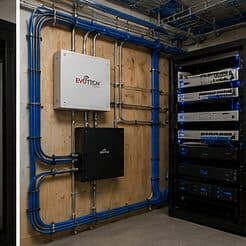
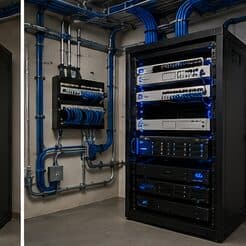
- Equipment room sized for every system, with power and ventilation
- Rated penetrations sleeved and firestopped properly
What changes whole-home & multi-zone audio from job to job
Scope moves with zone count and whether the space is pre- or post-construction.
- Number of zones and speakers per zone
- Amplifier topology and source count
- In-ceiling/in-wall versus surface or bookshelf speakers
- Run lengths and whether constant-voltage distribution is needed
- Pre-construction wiring versus finished-space retrofit
- Control method: keypads, app, or both
Houston: what the location changes
The starting point for any Houston job is one local fact. Building stock spanning multiple construction eras within short distances, producing very different ceiling and pathway conditions. That single condition shapes where cable can run, where equipment can sit, and how coverage is laid out — more than any spec sheet does. Two more conditions weigh on it. Slab-on-grade foundations dominate residential construction, which pushes retrofit cable routes into the attic rather than under the floor. Gulf Coast humidity and heavy rainfall events make exterior equipment sealing and drip-loop practice a routine requirement rather than an optional detail. Together they make the route specific to this pocket, which is why a short walkthrough or a few clear photos settle the scope faster than a floor plan can.
- Building stock spanning multiple construction eras within short distances, producing very different ceiling and pathway conditions
- Slab-on-grade foundations dominate residential construction, which pushes retrofit cable routes into the attic rather than under the floor
- Gulf Coast humidity and heavy rainfall events make exterior equipment sealing and drip-loop practice a routine requirement rather than an optional detail
- Summer attic temperatures constrain the working window for residential retrofit and rooftop-adjacent work
- Mixed land-use patterns place commercial, light industrial, and residential structures adjacent to each other, so neighbouring buildings often need entirely different approaches
Getting it done in Houston
A multi-zone system is commissioned by walking the zones, not by confirming the amplifier powers on.
Camera positions are among the cheapest things to prewire and among the most annoying to retrofit, because they are usually exterior, high, and behind finished soffit. Running cable to likely positions during rough-in preserves the option at almost no cost.
Getting Houston work done means planning around the site as it actually is. Summer attic temperatures constrain the working window for residential retrofit and rooftop-adjacent work. Mixed land-use patterns place commercial, light industrial, and residential structures adjacent to each other, so neighbouring buildings often need entirely different approaches. Both matter as much as the design to how and when the work happens. The scope is drawn from the real property, the coverage is stated as a service area rather than an office, and unverifiable specifics about Houston are kept off the page on purpose.
Popular services nearby
Frequently searched near this area — the pages people look for most.
Frequently asked questions
Is whole-home & multi-zone audio for new construction different in Houston?
The sector needs stay the same, but the install changes with the place. In Houston, the conditions above — not the new construction label — decide routes, mounting, and equipment placement, which is why this page pairs all three.
How is whole-home audio different from a home theater?
A home theater is one room done in surround for watching. Whole-home audio is music distributed across many rooms with independent control — the kitchen, the patio, the office each on their own. Different goal, different design: theater is about one room's immersion, distributed audio is about zones and control.