Fireplace TV mounting for new construction, in Houston
Fireplace TV mounting for new construction in Houston is a three-part question: what fireplace tv mounting involves, what new construction need from it, and what Houston changes about the install. Building stock spanning multiple construction eras within short distances, producing very different ceiling and pathway conditions.
Heat is the safety question. A wood-burning or older gas fireplace can send real heat up the wall, and electronics above it need either enough clearance and a mantel that deflects heat, or a fireplace whose output does not reach the mounting zone. It is worth assessing honestly before committing, because the fix for excessive heat is not a bracket.
Decide locations, claim pathways, leave capacity
Three things matter more than everything else combined: agreeing device locations before rough-in, claiming pathway before the other trades fill the ceiling, and running more capacity than the current plan requires.
The third is the one most often skipped and most often regretted. An extra run to a likely future access point, camera, or display position costs very little while the walls are open.
- Device locations agreed and marked before rough-in begins
- Pathway claimed early, since low voltage is usually last into the ceiling
- Spare runs to likely future positions while walls are open
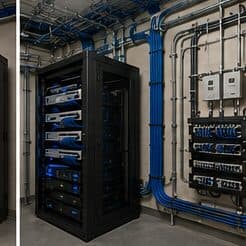
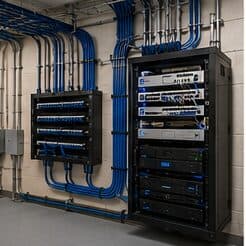
- Equipment room sized for every system, with power and ventilation
- Rated penetrations sleeved and firestopped properly
What changes fireplace tv mounting from job to job
Fireplace scope depends on the surround, the heat, and the mount type.
- Fireplace type and heat output into the mounting zone
- Surround construction: drywall, brick, stone, or masonry
- Fixed, tilting, or pull-down mount
- Mantel depth and clearance
- Cable routing difficulty around the structure
- TV size and weight against the anchoring
Houston: what the location changes
What separates a Houston scope from the rest of the city is concrete and local. Building stock spanning multiple construction eras within short distances, producing very different ceiling and pathway conditions. Slab-on-grade foundations dominate residential construction, which pushes retrofit cable routes into the attic rather than under the floor. Gulf Coast humidity and heavy rainfall events make exterior equipment sealing and drip-loop practice a routine requirement rather than an optional detail. That short list is what actually drives the design in this pocket, and it is why photographs or a brief site visit beat a floor plan — the plan follows the building's real constraints, not the neighborhood name on the map.
- Building stock spanning multiple construction eras within short distances, producing very different ceiling and pathway conditions
- Slab-on-grade foundations dominate residential construction, which pushes retrofit cable routes into the attic rather than under the floor
- Gulf Coast humidity and heavy rainfall events make exterior equipment sealing and drip-loop practice a routine requirement rather than an optional detail
- Summer attic temperatures constrain the working window for residential retrofit and rooftop-adjacent work
- Mixed land-use patterns place commercial, light industrial, and residential structures adjacent to each other, so neighbouring buildings often need entirely different approaches
Getting it done in Houston
A fireplace mount is checked for angle, movement, and a secure fixing.
Camera positions are among the cheapest things to prewire and among the most annoying to retrofit, because they are usually exterior, high, and behind finished soffit. Running cable to likely positions during rough-in preserves the option at almost no cost.
Execution in Houston is planned around real conditions, not a template. Summer attic temperatures constrain the working window for residential retrofit and rooftop-adjacent work. Mixed land-use patterns place commercial, light industrial, and residential structures adjacent to each other, so neighbouring buildings often need entirely different approaches. These decide the sequence, the access, and the method as much as the design does. EVOTECH describes Houston as coverage rather than a place it occupies, and omits any area detail it cannot confirm — building and site conditions only, no invented landmarks or promised arrival times.
Popular services nearby
Frequently searched near this area — the pages people look for most.
Frequently asked questions
Is fireplace tv mounting for new construction different in Houston?
The sector needs stay the same, but the install changes with the place. In Houston, the conditions above — not the new construction label — decide routes, mounting, and equipment placement, which is why this page pairs all three.
Is mounting a TV above the fireplace a bad idea?
It is a compromise, and worth naming as one. The screen usually ends up above comfortable seated eye level, and heat can be a concern on some fireplaces. A pull-down mount resolves the height by bringing the screen down to eye level in use, and a heat assessment settles the safety question. Sometimes the honest answer is a different wall, but with the right mount and a suitable fireplace it works well.