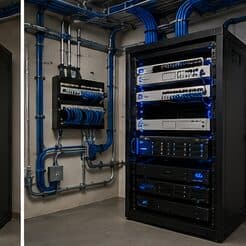
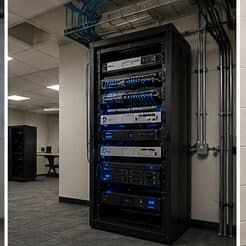
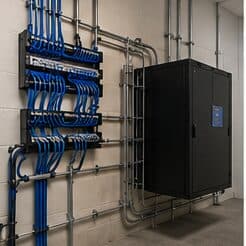
NVR installation for new construction, in Conroe
NVR installation for new construction in Conroe is a three-part question: what nvr installation involves, what new construction need from it, and what Conroe changes about the install. Fast commercial and medical growth with newer buildouts and tenant-improvement conditions.
A network video recorder receives streams from the cameras, writes them to disk, and serves them back for review. Its capacity determines how far back the footage goes, and that number is arithmetic, not a product feature: camera count, resolution, frame rate, compression efficiency, and how much of the day actually gets recorded all multiply together against the drive capacity.
One window, and it does not reopen
Low-voltage rough-in happens in a specific slot: after framing and electrical, before insulation and drywall. Inside that window, running a cable anywhere is straightforward. Once drywall goes up, the same cable costs many times more and sometimes cannot be run at all.
The asymmetry is the whole story of new-construction low voltage. Decisions made cheaply during rough-in become expensive or impossible afterwards, which is why the pre-rough-in planning conversation is worth more than any equipment choice made later.
- Rough-in window sits between electrical and drywall
- Upstream delays compress the window without extending the deadline
- Post-drywall changes cost many times more, if they are possible at all
- Finish work happens months later, after paint and ceilings
Where nvr installation goes wrong — and how it's avoided
Recorder mistakes usually surface weeks later, which is what makes them expensive.
- Sizing storage from a marketing retention figure rather than a calculation
- Assuming motion-only recording and then configuring continuous
- Fitting general-purpose drives to a continuous-write workload
- Putting the recorder in a sealed cabinet where it overheats
- Forwarding a port directly to the recorder for remote viewing
- Leaving default credentials and never creating individual accounts
- Never testing an export until an incident requires one
Conroe: what the location changes
In Conroe, the plan is built outward from the conditions that are actually here. Fast commercial and medical growth with newer buildouts and tenant-improvement conditions. Older commercial stock needing pathway remediation. Larger residential properties, including lake-area homes with outbuildings. Each one changes where cable can run, where equipment can sit, and how coverage is shaped, which is why a walkthrough settles a Conroe scope faster than any generic estimate.
- Fast commercial and medical growth with newer buildouts and tenant-improvement conditions
- Older commercial stock needing pathway remediation
- Larger residential properties, including lake-area homes with outbuildings
- Detached structures and longer runs raising distance considerations
- Ongoing new construction where prewire is the high-value decision
Getting it done in Conroe
Verification means letting the system run and measuring, because the calculation is a projection until real footage lands on the disk.
Full system design is often not finished when the rough-in window arrives. That is normal, and it is not a reason to skip the pathway. Running conduit or sleeves to likely positions preserves the option cheaply even when the eventual equipment is undecided.
Getting Conroe work done means planning around the site as it actually is. Detached structures and longer runs raising distance considerations. Ongoing new construction where prewire is the high-value decision. Both matter as much as the design to how and when the work happens. The scope is drawn from the real property, the coverage is stated as a service area rather than an office, and unverifiable specifics about Conroe are kept off the page on purpose.
Popular services nearby
Frequently searched near this area — the pages people look for most.
Frequently asked questions
Is nvr installation for new construction different in Conroe?
The sector needs stay the same, but the install changes with the place. In Conroe, the conditions above — not the new construction label — decide routes, mounting, and equipment placement, which is why this page pairs all three.
How much storage is needed for 30 days of footage?
It is a calculation, not a fixed number: per-camera bitrate multiplied by hours recorded per day multiplied by thirty, summed across cameras. Resolution, frame rate, recording mode, and how busy each scene is all move the result substantially. Two eight-camera systems can differ by a factor of three for the same retention target.