Why this page exists
Technology for new construction in Bridgeland and Towne Lake sits where two things meet: how new construction actually operate, and what Bridgeland and Towne Lake specifically brings to the building. 77433 is some of the newest master-planned Cypress — Bridgeland, Towne Lake, and Fairfield — with current-generation homes and fiber-ready infrastructure.
Three things matter more than everything else combined: agreeing device locations before rough-in, claiming pathway before the other trades fill the ceiling, and running more capacity than the current plan requires.
Decide locations, claim pathways, leave capacity
Three things matter more than everything else combined: agreeing device locations before rough-in, claiming pathway before the other trades fill the ceiling, and running more capacity than the current plan requires.
The third is the one most often skipped and most often regretted. An extra run to a likely future access point, camera, or display position costs very little while the walls are open.
- Device locations agreed and marked before rough-in begins
- Pathway claimed early, since low voltage is usually last into the ceiling
- Spare runs to likely future positions while walls are open
- Equipment room sized for every system, with power and ventilation
- Rated penetrations sleeved and firestopped properly
Bridgeland and Towne Lake: what the location adds
In Bridgeland and Towne Lake, the plan is built outward from the conditions that are actually here. 77433 is some of the newest master-planned Cypress — Bridgeland, Towne Lake, and Fairfield — with current-generation homes and fiber-ready infrastructure. New homes routinely ship with a structured-wiring enclosure and home-run drops, so work is often activation, upgrade, and extension. Lake-oriented communities put boat docks, waterfront patios, and long rear lots in play for outdoor audio and camera coverage. Each one changes where cable can run, where equipment can sit, and how coverage is shaped, which is why a walkthrough settles a Bridgeland and Towne Lake scope faster than any generic estimate.
- 77433 is some of the newest master-planned Cypress — Bridgeland, Towne Lake, and Fairfield — with current-generation homes and fiber-ready infrastructure
- New homes routinely ship with a structured-wiring enclosure and home-run drops, so work is often activation, upgrade, and extension
- Lake-oriented communities put boat docks, waterfront patios, and long rear lots in play for outdoor audio and camera coverage
- Media rooms and covered outdoor living spaces make AV and outdoor-speaker prewire standard requests
- HOA architectural review governs exterior-facing camera and equipment placement
What to rough in even without a final design
Full system design is often not finished when the rough-in window arrives. That is normal, and it is not a reason to skip the pathway. Running conduit or sleeves to likely positions preserves the option cheaply even when the eventual equipment is undecided.
For a commercial building, the reliable rough-in set is: cable to every likely device outlet, ceiling positions for access points spaced for the intended coverage, camera positions at entries and approaches, door positions with cable to the controller location, and pathway to any likely display or AV position. Plus, in every case, a properly located equipment room.
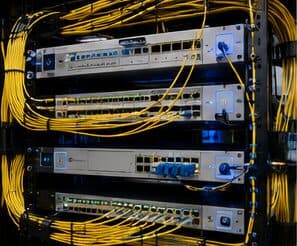
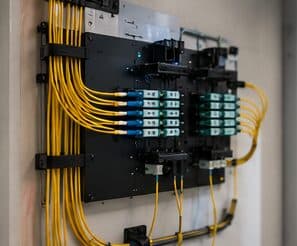
The equipment room deserves particular emphasis because it is the most commonly under-provisioned item. It has to hold the network rack, camera recorder, access-control panel, and any AV equipment, with dedicated power, ventilation, and clearance to work. Sizing it from the network alone is a decision that gets discovered eighteen months later.
- Sleeves and conduit to likely positions even before final design
- Ceiling access-point positions spaced for the intended coverage
- Camera positions at entries, approaches, and service areas
- Cable from every controlled door to the controller position
- Equipment room with dedicated power, ventilation, and working clearance
Installing in Bridgeland and Towne Lake
Camera positions are among the cheapest things to prewire and among the most annoying to retrofit, because they are usually exterior, high, and behind finished soffit. Running cable to likely positions during rough-in preserves the option at almost no cost.
On site, the schedule and working method turn on conditions like these. Media rooms and covered outdoor living spaces make AV and outdoor-speaker prewire standard requests. HOA architectural review governs exterior-facing camera and equipment placement. Both shape how and when a crew can actually operate, which is why EVOTECH scopes each Bridgeland and Towne Lake job from the property itself rather than assuming one approach fits every address. Coverage is stated as a service area, never an office claim, and anything about Bridgeland and Towne Lake that cannot be verified is left out instead of invented.
Frequently asked questions
What do new construction in Bridgeland and Towne Lake usually need first?
It varies by site, but the pattern for new construction holds in Bridgeland and Towne Lake: get the network and cabling backbone right, then layer cameras and access on top. What Bridgeland and Towne Lake changes is the physical install — the conditions listed above drive routes and equipment placement more than the sector alone does.
What has to be decided before rough-in?
Device locations, the equipment room position, and the pathway plan. Equipment selection can wait — you can run cable to a position without knowing which camera or access point will go there. What cannot wait is the decision about where things go, because that is what determines where cable is pulled while the walls are open.