Commercial IT solutions for multifamily properties, in Webster
Commercial IT solutions for multifamily properties in Webster is a three-part question: what commercial it solutions involves, what multifamily properties need from it, and what Webster changes about the install. A concentration of medical suites with controlled areas and clinical scheduling.
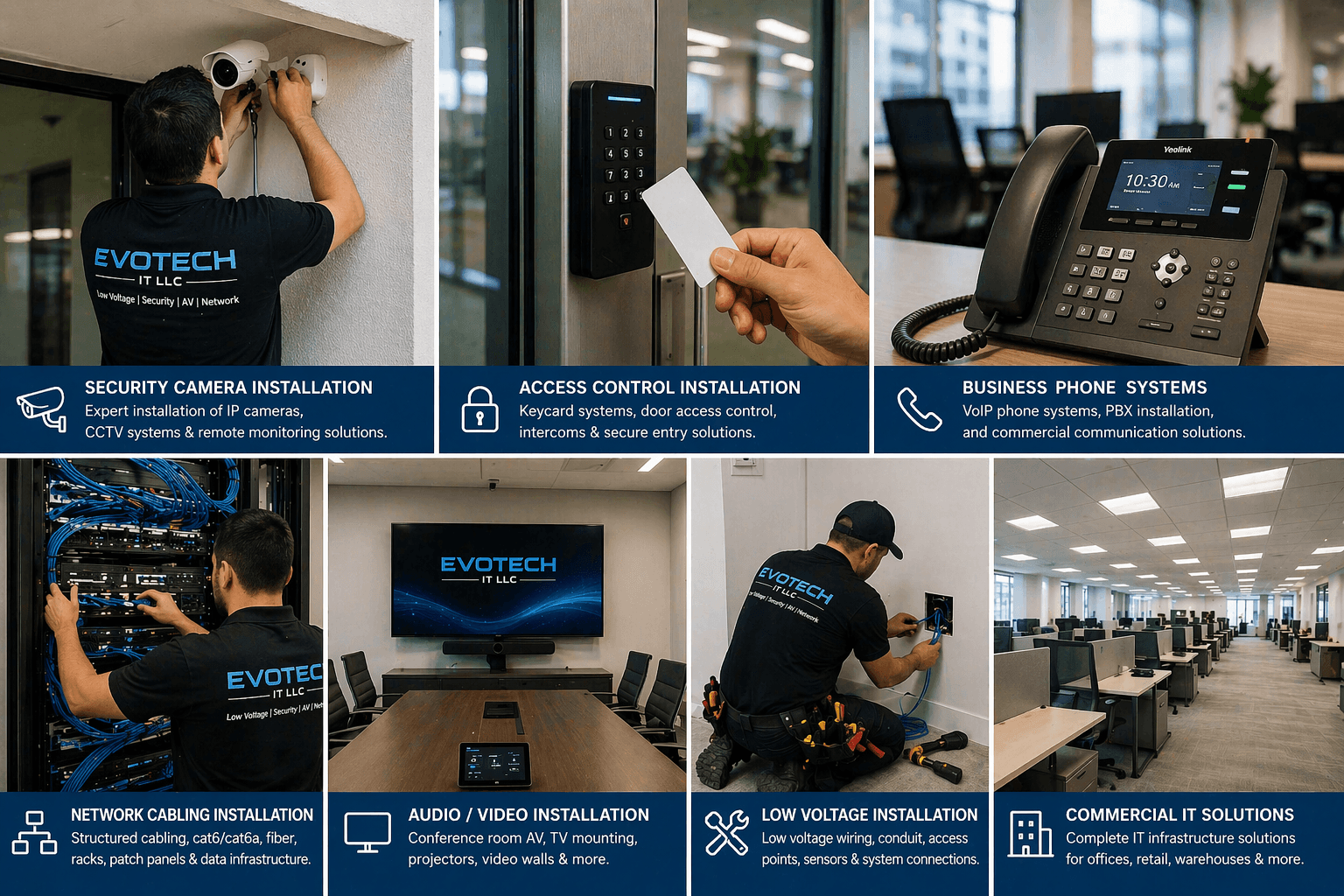
The value is in the coordination. Systems bought piecemeal end up on one flat network with no segmentation, with cabling that suits none of them well, and with nobody able to say why something does not work because each vendor points at the others. A coordinated design puts them on shared, properly segmented infrastructure and gives the business one number to call.
Entry, packages, and parking
Camera coverage focuses on the points where the property has a legitimate operational interest: building entries, package rooms, parking areas and garages, amenity spaces, and the leasing office. Framing at entries should be tight enough for identification; parking coverage is usually about vehicle movement rather than identifying individuals.
Package areas have become one of the most-requested views, and they are also one of the easier ones to get right: a controlled room with an access record and a camera framed on the door covers most of what gets asked.
Cameras are not positioned to view into individual units, private balconies, or windows. That boundary is set at design and is not negotiable regardless of how a request is framed.
- Building entries framed for identification
- Package room door with access records alongside footage
- Parking areas and garages framed for vehicle movement
- Amenity spaces and leasing office
- No camera positioned to view into units, balconies, or windows
What drives the cost of commercial it solutions here
Breadth, site count, and continuity requirements drive the cost more than any single system.
- Number of systems and the integration between them
- Site size and count
- Continuity provision: UPS, failover, and equipment-room build
- Growth headroom designed in
- Migration of existing systems versus new build
- Whether ongoing management is included
Webster: what the location changes
What separates a Webster scope from the rest of the city is concrete and local. A concentration of medical suites with controlled areas and clinical scheduling. Retail and hospitality venues requiring guest and payment segmentation. Multi-tenant buildings with base-building rules on riser and core access. That short list is what actually drives the design in this pocket, and it is why photographs or a brief site visit beat a floor plan — the plan follows the building's real constraints, not the neighborhood name on the map.
- A concentration of medical suites with controlled areas and clinical scheduling
- Retail and hospitality venues requiring guest and payment segmentation
- Multi-tenant buildings with base-building rules on riser and core access
- Tenant-improvement buildouts with suspended-grid ceilings and usable pathway
- Slab-foundation residential secondary to the commercial base
Getting it done in Webster
A coordinated system is verified as a whole, not one component at a time.
A multifamily property runs two distinct technology environments. Residents have their own connectivity inside their units, generally provided by whatever service they select. The property operates everything else: common-area wireless, controlled entry, intercom, package rooms, amenity spaces, cameras, and the office network.
Getting Webster work done means planning around the site as it actually is. Tenant-improvement buildouts with suspended-grid ceilings and usable pathway. Slab-foundation residential secondary to the commercial base. Both matter as much as the design to how and when the work happens. The scope is drawn from the real property, the coverage is stated as a service area rather than an office, and unverifiable specifics about Webster are kept off the page on purpose.
Popular services nearby
Frequently searched near this area — the pages people look for most.
Frequently asked questions
Is commercial it solutions for multifamily properties different in Webster?
The sector needs stay the same, but the install changes with the place. In Webster, the conditions above — not the multifamily properties label — decide routes, mounting, and equipment placement, which is why this page pairs all three.
How is this different from just hiring separate installers?
Coordination and accountability. Separate installers each optimise their own system, which is how a business ends up with everything on one flat network, cabling that suits nobody, and no one able to say why something does not work. A coordinated design puts every system on shared, segmented infrastructure and gives you one party accountable for the whole thing working — which is usually cheaper over the life of the fit-out, not just simpler.