NVR installation for multifamily properties, in Spring
NVR installation for multifamily properties in Spring is a three-part question: what nvr installation involves, what multifamily properties need from it, and what Spring changes about the install. Retail and food-service commercial base where payment-system separation is a standing requirement.
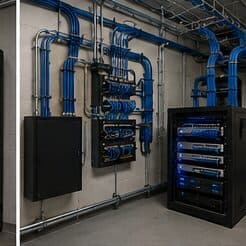
A network video recorder receives streams from the cameras, writes them to disk, and serves them back for review. Its capacity determines how far back the footage goes, and that number is arithmetic, not a product feature: camera count, resolution, frame rate, compression efficiency, and how much of the day actually gets recorded all multiply together against the drive capacity.
Occupied buildings and turnover
Multifamily properties are occupied continuously, which means work in corridors and common areas happens around residents, with containment, clear signage, and attention to noise during reasonable hours. Access to individual units, where required, needs the property's own notice procedures.
Turnover shapes the administrative design more than the physical one. Credentials need to be issued and revoked quickly and by on-site staff, which means the system's day-to-day administration has to be genuinely simple. A system requiring a specialist to add a resident will not be maintained accurately.
- Continuous occupancy requiring containment and noise consideration
- Unit access following the property's notice procedures
- Credential administration simple enough for on-site staff
- Phased work across buildings to limit disruption
- Documentation that survives staff turnover
What changes nvr installation from job to job
Retention target and scene activity are the two dominant inputs.
- Camera count, resolution, and frame rate
- Retention target in days
- Recording mode and schedule
- Scene complexity, which drives real compression efficiency
- Drive capacity, count, and whether redundancy is required
- Recorder location, ventilation, and physical security
- Remote-access requirements and number of users
Spring: what the location changes
Retail and food-service commercial base where payment-system separation is a standing requirement. In Spring, that is where the plan begins, because it changes cable paths, device placement, and access-point counts before anything else does. Ceiling construction varying considerably between adjacent units, from open deck to hard lid to suspended grid. Restaurant kitchen environments requiring equipment placement away from heat, steam, and grease-laden air. None of these are generic checklist items — each moves the design in a direction a citywide assumption would miss, and the honest recommendation always depends on what this particular property allows.
- Retail and food-service commercial base where payment-system separation is a standing requirement
- Ceiling construction varying considerably between adjacent units, from open deck to hard lid to suspended grid
- Restaurant kitchen environments requiring equipment placement away from heat, steam, and grease-laden air
- Storefront glazing on retail units complicating daylight entrance camera placement
- Residential areas following the regional slab-foundation and attic-routing pattern
Getting it done in Spring
Verification means letting the system run and measuring, because the calculation is a projection until real footage lands on the disk.
The systems residents notice are entry and packages. An entry system that reliably lets residents in and lets them grant access to visitors, and a package room that works, generate more satisfaction than any other technology on the property.
On site, the schedule and working method turn on conditions like these. Storefront glazing on retail units complicating daylight entrance camera placement. Residential areas following the regional slab-foundation and attic-routing pattern. Both shape how and when a crew can actually operate, which is why EVOTECH scopes each Spring job from the property itself rather than assuming one approach fits every address. Coverage is stated as a service area, never an office claim, and anything about Spring that cannot be verified is left out instead of invented.
Frequently asked questions
Is nvr installation for multifamily properties different in Spring?
The sector needs stay the same, but the install changes with the place. In Spring, the conditions above — not the multifamily properties label — decide routes, mounting, and equipment placement, which is why this page pairs all three.
How much storage is needed for 30 days of footage?
It is a calculation, not a fixed number: per-camera bitrate multiplied by hours recorded per day multiplied by thirty, summed across cameras. Resolution, frame rate, recording mode, and how busy each scene is all move the result substantially. Two eight-camera systems can differ by a factor of three for the same retention target.