Commercial IT solutions for multifamily properties, in Spring
Commercial IT solutions for multifamily properties in Spring is a three-part question: what commercial it solutions involves, what multifamily properties need from it, and what Spring changes about the install. Retail and food-service commercial base where payment-system separation is a standing requirement.
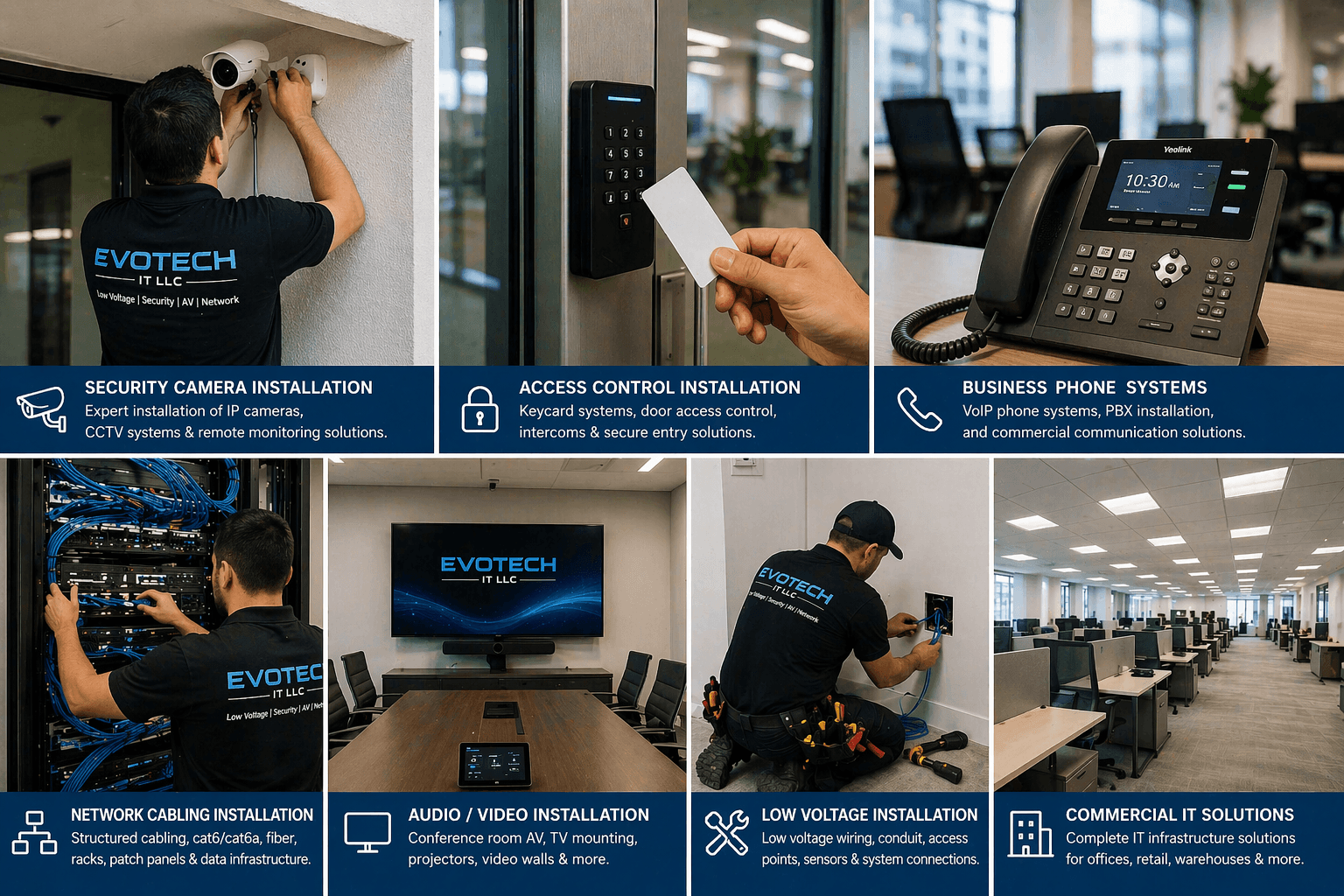
A business does not need a network, then some cameras, then a phone system, then Wi-Fi, each chosen by a different vendor at a different time. It needs those systems designed to work together on shared infrastructure, sized for how the business will grow, and delivered so one party is accountable for the whole thing working. That is what commercial IT solutions means here: the full low-voltage and network stack — structured cabling, managed switching and Wi-Fi, cameras, access control, and phones — planned as a single system rather than assembled from disconnected projects.
Occupied buildings and turnover
Multifamily properties are occupied continuously, which means work in corridors and common areas happens around residents, with containment, clear signage, and attention to noise during reasonable hours. Access to individual units, where required, needs the property's own notice procedures.
Turnover shapes the administrative design more than the physical one. Credentials need to be issued and revoked quickly and by on-site staff, which means the system's day-to-day administration has to be genuinely simple. A system requiring a specialist to add a resident will not be maintained accurately.
- Continuous occupancy requiring containment and noise consideration
- Unit access following the property's notice procedures
- Credential administration simple enough for on-site staff
- Phased work across buildings to limit disruption
- Documentation that survives staff turnover
What changes commercial it solutions from job to job
Scope is driven by the number of systems, the site count, and the continuity requirements.
- Which systems are in scope and how they integrate
- Site size, count, and whether it is a fit-out or a relocation
- Uptime and business-continuity requirements
- Growth headroom designed into the infrastructure
- Existing systems to migrate versus new installation
- Ongoing support and management expectations
Spring: what the location changes
In Spring, the plan is built outward from the conditions that are actually here. Retail and food-service commercial base where payment-system separation is a standing requirement. Ceiling construction varying considerably between adjacent units, from open deck to hard lid to suspended grid. Restaurant kitchen environments requiring equipment placement away from heat, steam, and grease-laden air. Each one changes where cable can run, where equipment can sit, and how coverage is shaped, which is why a walkthrough settles a Spring scope faster than any generic estimate.
- Retail and food-service commercial base where payment-system separation is a standing requirement
- Ceiling construction varying considerably between adjacent units, from open deck to hard lid to suspended grid
- Restaurant kitchen environments requiring equipment placement away from heat, steam, and grease-laden air
- Storefront glazing on retail units complicating daylight entrance camera placement
- Residential areas following the regional slab-foundation and attic-routing pattern
Getting it done in Spring
A coordinated system is verified as a whole, not one component at a time.
The systems residents notice are entry and packages. An entry system that reliably lets residents in and lets them grant access to visitors, and a package room that works, generate more satisfaction than any other technology on the property.
Getting Spring work done means planning around the site as it actually is. Storefront glazing on retail units complicating daylight entrance camera placement. Residential areas following the regional slab-foundation and attic-routing pattern. Both matter as much as the design to how and when the work happens. The scope is drawn from the real property, the coverage is stated as a service area rather than an office, and unverifiable specifics about Spring are kept off the page on purpose.
Frequently asked questions
Is commercial it solutions for multifamily properties different in Spring?
The sector needs stay the same, but the install changes with the place. In Spring, the conditions above — not the multifamily properties label — decide routes, mounting, and equipment placement, which is why this page pairs all three.
How is this different from just hiring separate installers?
Coordination and accountability. Separate installers each optimise their own system, which is how a business ends up with everything on one flat network, cabling that suits nobody, and no one able to say why something does not work. A coordinated design puts every system on shared, segmented infrastructure and gives you one party accountable for the whole thing working — which is usually cheaper over the life of the fit-out, not just simpler.