Video-doorbell installation for multifamily properties, in Katy
Video-doorbell installation for multifamily properties in Katy is a three-part question: what video-doorbell installation involves, what multifamily properties need from it, and what Katy changes about the install. Housing stock skewed toward newer, larger single-family construction with wide floor plans that exceed single-router coverage.
The other two are physical. A doorbell mounted at standard button height sees a close-up of a visitor's chest rather than their face, and one mounted around a corner or behind a column watches the wall. Mounting height and angle — with a wedge or angled bracket where the approach is off to one side — is what turns an installed doorbell into a useful one.
Occupied buildings and turnover
Multifamily properties are occupied continuously, which means work in corridors and common areas happens around residents, with containment, clear signage, and attention to noise during reasonable hours. Access to individual units, where required, needs the property's own notice procedures.
Turnover shapes the administrative design more than the physical one. Credentials need to be issued and revoked quickly and by on-site staff, which means the system's day-to-day administration has to be genuinely simple. A system requiring a specialist to add a resident will not be maintained accurately.
- Continuous occupancy requiring containment and noise consideration
- Unit access following the property's notice procedures
- Credential administration simple enough for on-site staff
- Phased work across buildings to limit disruption
- Documentation that survives staff turnover
Where video-doorbell installation goes wrong — and how it's avoided
Doorbell installs go wrong in a small number of consistent ways.
- Fitting the device to an under-rated transformer and chasing intermittent faults
- Mounting at button height and getting torso footage
- Ignoring an off-centre approach path that leaves visitors out of frame
- Not checking wireless signal at the door before mounting
- Leaving motion zones at default so the street triggers constant alerts
- Drilling into brick or stone without the right anchors and creating a leak path
Katy: what the location changes
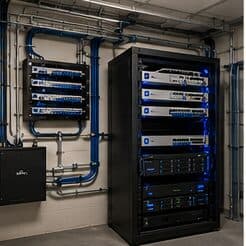
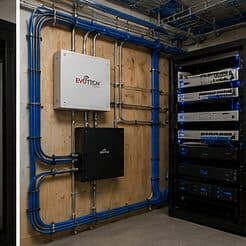
What separates a Katy scope from the rest of the city is concrete and local. Housing stock skewed toward newer, larger single-family construction with wide floor plans that exceed single-router coverage. Structured media panels commonly present but frequently located in a garage or perimeter utility space rather than centrally. Builder-installed cable often terminated to a panel but not extended to ceiling positions suitable for access points. That short list is what actually drives the design in this pocket, and it is why photographs or a brief site visit beat a floor plan — the plan follows the building's real constraints, not the neighborhood name on the map.
- Housing stock skewed toward newer, larger single-family construction with wide floor plans that exceed single-router coverage
- Structured media panels commonly present but frequently located in a garage or perimeter utility space rather than centrally
- Builder-installed cable often terminated to a panel but not extended to ceiling positions suitable for access points
- Slab foundations with accessible attics, making attic-to-interior-wall routing the standard retrofit path
- Suburban commercial development in retail pads and medical suites with suspended-grid ceilings and comparatively straightforward pathway
Getting it done in Katy
Verification is about the recording and the notification path, not just the button working.
The systems residents notice are entry and packages. An entry system that reliably lets residents in and lets them grant access to visitors, and a package room that works, generate more satisfaction than any other technology on the property.
Execution in Katy is planned around real conditions, not a template. Slab foundations with accessible attics, making attic-to-interior-wall routing the standard retrofit path. Suburban commercial development in retail pads and medical suites with suspended-grid ceilings and comparatively straightforward pathway. These decide the sequence, the access, and the method as much as the design does. EVOTECH describes Katy as coverage rather than a place it occupies, and omits any area detail it cannot confirm — building and site conditions only, no invented landmarks or promised arrival times.
Frequently asked questions
Is video-doorbell installation for multifamily properties different in Katy?
The sector needs stay the same, but the install changes with the place. In Katy, the conditions above — not the multifamily properties label — decide routes, mounting, and equipment placement, which is why this page pairs all three.
Why does the doorbell keep going offline or restarting?
Most often the transformer. Many houses have a transformer sized for a mechanical chime, which is a much smaller load than a camera doorbell. The device appears to work until it draws peak current — usually at the button press — and then drops. Confirming the transformer meets the device's stated voltage and VA rating resolves a large share of these cases.