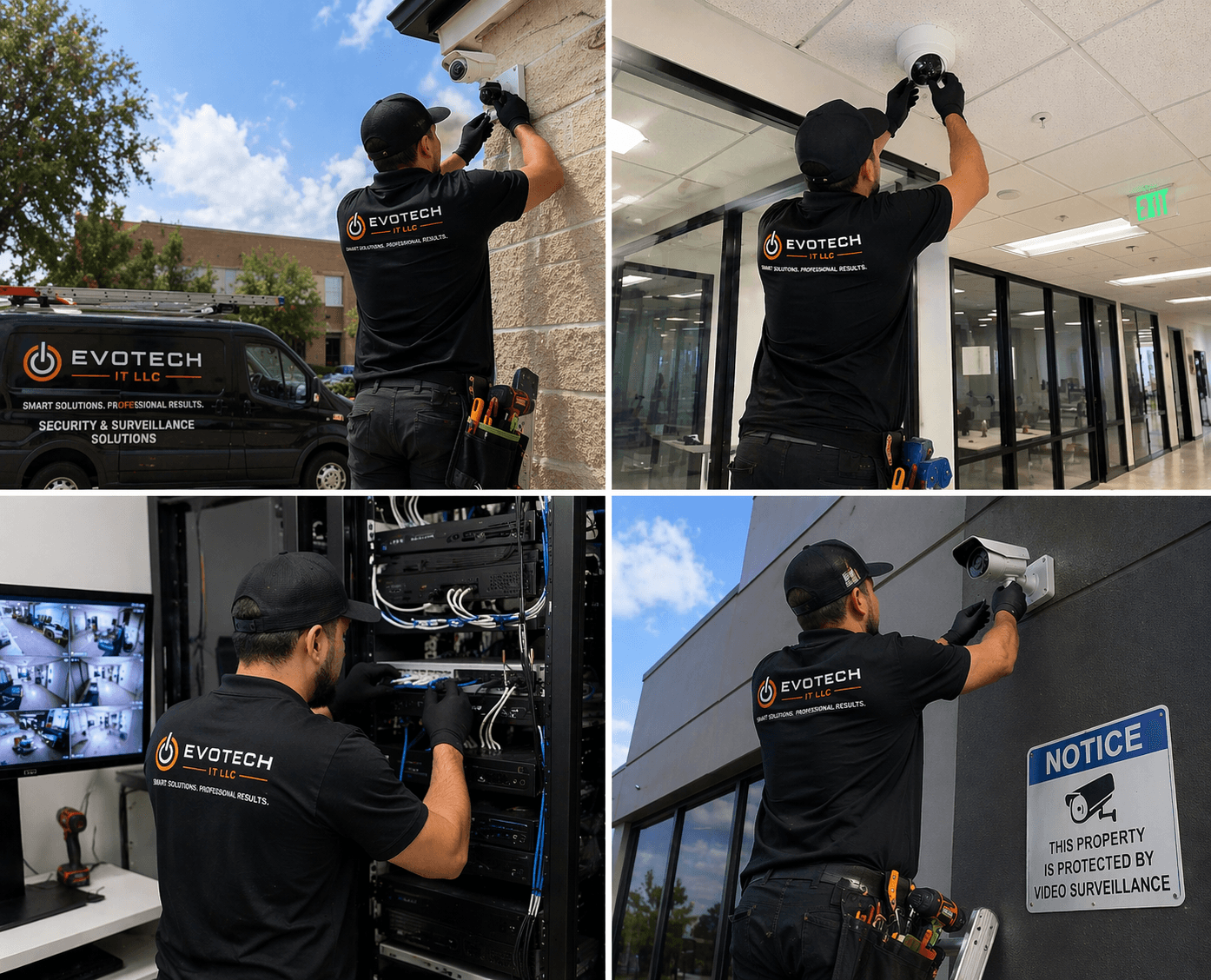
Security-camera installation for multifamily properties, in Katy
Security-camera installation for multifamily properties in Katy is a three-part question: what security-camera installation involves, what multifamily properties need from it, and what Katy changes about the install. Housing stock skewed toward newer, larger single-family construction with wide floor plans that exceed single-router coverage.
The useful design question is not how many cameras a property needs. It is what each camera has to accomplish. Detecting that a person is present, recognising someone you already know, and identifying a stranger from footage are three different requirements, and they need increasing pixel density on the subject. Planning guidance commonly cited from industry standards puts detection in the region of ten pixels per foot of subject, recognition around forty, and identification around eighty.
Occupied buildings and turnover
Multifamily properties are occupied continuously, which means work in corridors and common areas happens around residents, with containment, clear signage, and attention to noise during reasonable hours. Access to individual units, where required, needs the property's own notice procedures.
Turnover shapes the administrative design more than the physical one. Credentials need to be issued and revoked quickly and by on-site staff, which means the system's day-to-day administration has to be genuinely simple. A system requiring a specialist to add a resident will not be maintained accurately.
- Continuous occupancy requiring containment and noise consideration
- Unit access following the property's notice procedures
- Credential administration simple enough for on-site staff
- Phased work across buildings to limit disruption
- Documentation that survives staff turnover
Where security-camera installation goes wrong — and how it's avoided
Camera systems disappoint for predictable, avoidable reasons.
- Buying camera count instead of designing coverage objectives
- Mounting everything high and wide, then expecting identification
- Aiming a camera at a glass entrance from inside during daylight
- Sizing storage for resolution but not for the retention period
- Leaving default credentials and default remote-access settings in place
- Skipping the after-dark review and discovering the night image months later
Katy: what the location changes
In Katy, the plan is built outward from the conditions that are actually here. Housing stock skewed toward newer, larger single-family construction with wide floor plans that exceed single-router coverage. Structured media panels commonly present but frequently located in a garage or perimeter utility space rather than centrally. Builder-installed cable often terminated to a panel but not extended to ceiling positions suitable for access points. Each one changes where cable can run, where equipment can sit, and how coverage is shaped, which is why a walkthrough settles a Katy scope faster than any generic estimate.
- Housing stock skewed toward newer, larger single-family construction with wide floor plans that exceed single-router coverage
- Structured media panels commonly present but frequently located in a garage or perimeter utility space rather than centrally
- Builder-installed cable often terminated to a panel but not extended to ceiling positions suitable for access points
- Slab foundations with accessible attics, making attic-to-interior-wall routing the standard retrofit path
- Suburban commercial development in retail pads and medical suites with suspended-grid ceilings and comparatively straightforward pathway
Getting it done in Katy
A camera system is commissioned by looking at its recordings, not its live view. Live video on a monitor at midday tells you very little about what the recorded file will show at nine in the evening.
The systems residents notice are entry and packages. An entry system that reliably lets residents in and lets them grant access to visitors, and a package room that works, generate more satisfaction than any other technology on the property.
Getting Katy work done means planning around the site as it actually is. Slab foundations with accessible attics, making attic-to-interior-wall routing the standard retrofit path. Suburban commercial development in retail pads and medical suites with suspended-grid ceilings and comparatively straightforward pathway. Both matter as much as the design to how and when the work happens. The scope is drawn from the real property, the coverage is stated as a service area rather than an office, and unverifiable specifics about Katy are kept off the page on purpose.
Popular services nearby
Frequently searched near this area — the pages people look for most.
Frequently asked questions
Is security-camera installation for multifamily properties different in Katy?
The sector needs stay the same, but the install changes with the place. In Katy, the conditions above — not the multifamily properties label — decide routes, mounting, and equipment placement, which is why this page pairs all three.
How many cameras does a property need?
Count objectives, not walls. Each area needs a stated purpose — detect activity, recognise a known person, or identify a stranger — and the camera serving it is chosen for that purpose. A property with four well-framed cameras at the points that matter usually produces more useful footage than one with twelve wide shots covering everything approximately.