Commercial Wi-Fi for multifamily properties, in Katy
Commercial Wi-Fi for multifamily properties in Katy is a three-part question: what commercial wi-fi involves, what multifamily properties need from it, and what Katy changes about the install. Housing stock skewed toward newer, larger single-family construction with wide floor plans that exceed single-router coverage.
The second thing commercial wireless has to solve, which home networks do not, is separation. Guest devices, staff devices, point-of-sale terminals, cameras, and building systems have no business sharing one flat network. Keeping them apart limits what a compromised device can reach and makes troubleshooting far simpler.
Occupied buildings and turnover
Multifamily properties are occupied continuously, which means work in corridors and common areas happens around residents, with containment, clear signage, and attention to noise during reasonable hours. Access to individual units, where required, needs the property's own notice procedures.
Turnover shapes the administrative design more than the physical one. Credentials need to be issued and revoked quickly and by on-site staff, which means the system's day-to-day administration has to be genuinely simple. A system requiring a specialist to add a resident will not be maintained accurately.
- Continuous occupancy requiring containment and noise consideration
- Unit access following the property's notice procedures
- Credential administration simple enough for on-site staff
- Phased work across buildings to limit disruption
- Documentation that survives staff turnover
Where commercial wi-fi goes wrong — and how it's avoided
Commercial deployments fail in recognisable ways.
- Designing for coverage and discovering the capacity problem in the first all-hands meeting
- Running one flat network for staff, guests, payments, and cameras
- Surveying a warehouse before the racking is stocked
- Mounting access points above ceiling tiles for appearance
- Sizing the switch for today's AP count with no PoE headroom
- Leaving channel and power selection entirely automatic in a dense multi-tenant building
Katy: what the location changes
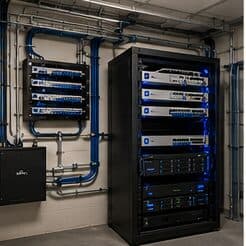
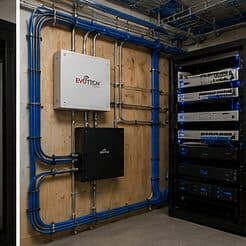
What separates a Katy scope from the rest of the city is concrete and local. Housing stock skewed toward newer, larger single-family construction with wide floor plans that exceed single-router coverage. Structured media panels commonly present but frequently located in a garage or perimeter utility space rather than centrally. Builder-installed cable often terminated to a panel but not extended to ceiling positions suitable for access points. That short list is what actually drives the design in this pocket, and it is why photographs or a brief site visit beat a floor plan — the plan follows the building's real constraints, not the neighborhood name on the map.
- Housing stock skewed toward newer, larger single-family construction with wide floor plans that exceed single-router coverage
- Structured media panels commonly present but frequently located in a garage or perimeter utility space rather than centrally
- Builder-installed cable often terminated to a panel but not extended to ceiling positions suitable for access points
- Slab foundations with accessible attics, making attic-to-interior-wall routing the standard retrofit path
- Suburban commercial development in retail pads and medical suites with suspended-grid ceilings and comparatively straightforward pathway
Getting it done in Katy
Commercial validation happens under load, because an empty office at eight in the morning tells you almost nothing about a full one at eleven.
The systems residents notice are entry and packages. An entry system that reliably lets residents in and lets them grant access to visitors, and a package room that works, generate more satisfaction than any other technology on the property.
Execution in Katy is planned around real conditions, not a template. Slab foundations with accessible attics, making attic-to-interior-wall routing the standard retrofit path. Suburban commercial development in retail pads and medical suites with suspended-grid ceilings and comparatively straightforward pathway. These decide the sequence, the access, and the method as much as the design does. EVOTECH describes Katy as coverage rather than a place it occupies, and omits any area detail it cannot confirm — building and site conditions only, no invented landmarks or promised arrival times.
Frequently asked questions
Is commercial wi-fi for multifamily properties different in Katy?
The sector needs stay the same, but the install changes with the place. In Katy, the conditions above — not the multifamily properties label — decide routes, mounting, and equipment placement, which is why this page pairs all three.
How many access points does a business space need?
It comes out of density rather than area. A quiet office floor might be covered by a handful of access points; a conference-heavy floor with the same square footage might need more, concentrated where people gather. The count is an output of counting devices per area and understanding what they do — which is why a walkthrough beats a per-square-foot rule.