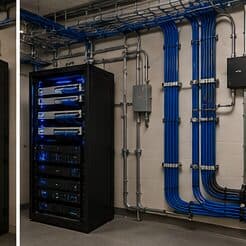
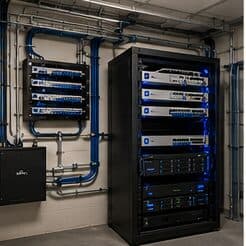
Low-voltage installation for multifamily properties, in Humble
Low-voltage installation for multifamily properties in Humble is a three-part question: what low-voltage installation involves, what multifamily properties need from it, and what Humble changes about the install. A retail and commercial hub with a broad mix of building ages.
The scheduling reality is that low voltage sits between the electrical rough-in and drywall, in a window that is often short and frequently compressed when earlier trades run late. Being ready to work in that window — with device locations agreed and the pathway plan settled — is most of what makes new-construction low voltage go smoothly.
Entry, packages, and parking
Camera coverage focuses on the points where the property has a legitimate operational interest: building entries, package rooms, parking areas and garages, amenity spaces, and the leasing office. Framing at entries should be tight enough for identification; parking coverage is usually about vehicle movement rather than identifying individuals.
Package areas have become one of the most-requested views, and they are also one of the easier ones to get right: a controlled room with an access record and a camera framed on the door covers most of what gets asked.
Cameras are not positioned to view into individual units, private balconies, or windows. That boundary is set at design and is not negotiable regardless of how a request is framed.
- Building entries framed for identification
- Package room door with access records alongside footage
- Parking areas and garages framed for vehicle movement
- Amenity spaces and leasing office
- No camera positioned to view into units, balconies, or windows
What drives the cost of low-voltage installation here
Scope breadth and schedule conditions drive low-voltage cost more than any single system does.
- Number of systems and total device count
- Pathway construction and whether tray or conduit is required
- Rated penetrations and firestopping
- Number of separate mobilisations the schedule forces
- Occupied versus unoccupied working conditions
- Equipment room build-out
- Commissioning and documentation depth
Humble: what the location changes
The starting point for any Humble job is one local fact. A retail and commercial hub with a broad mix of building ages. That single condition shapes where cable can run, where equipment can sit, and how coverage is laid out — more than any spec sheet does. Two more conditions weigh on it. Warehousing and distribution requiring aisle coverage and longer runs. Older commercial stock needing pathway remediation and rack cleanup. Together they make the route specific to this pocket, which is why a short walkthrough or a few clear photos settle the scope faster than a floor plan can.
- A retail and commercial hub with a broad mix of building ages
- Warehousing and distribution requiring aisle coverage and longer runs
- Older commercial stock needing pathway remediation and rack cleanup
- Retail point-of-sale environments requiring network segmentation
- Slab-foundation residential across established and newer neighbourhoods
Getting it done in Humble
Each system is commissioned on its own terms, but the low-voltage handover is the point where they are verified together.
A multifamily property runs two distinct technology environments. Residents have their own connectivity inside their units, generally provided by whatever service they select. The property operates everything else: common-area wireless, controlled entry, intercom, package rooms, amenity spaces, cameras, and the office network.
Getting Humble work done means planning around the site as it actually is. Retail point-of-sale environments requiring network segmentation. Slab-foundation residential across established and newer neighbourhoods. Both matter as much as the design to how and when the work happens. The scope is drawn from the real property, the coverage is stated as a service area rather than an office, and unverifiable specifics about Humble are kept off the page on purpose.
Frequently asked questions
Is low-voltage installation for multifamily properties different in Humble?
The sector needs stay the same, but the install changes with the place. In Humble, the conditions above — not the multifamily properties label — decide routes, mounting, and equipment placement, which is why this page pairs all three.
When should low-voltage work happen in a construction schedule?
Rough-in sits after electrical and framing and before insulation and drywall. Finish work — terminations, device mounting, and commissioning — happens after paint and ceilings. The risk is that upstream delays compress the rough-in window, so having device locations and pathway plans settled in advance is what keeps that window usable.