Data-jack installation for multifamily properties, in Humble
Data-jack installation for multifamily properties in Humble is a three-part question: what data-jack installation involves, what multifamily properties need from it, and what Humble changes about the install. A retail and commercial hub with a broad mix of building ages.
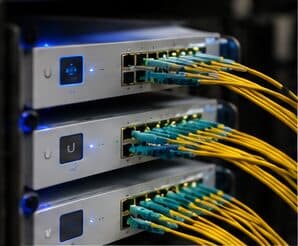
A data jack is the terminated outlet at the end of a horizontal run. It looks trivial, and it is the single most common place for a link to lose performance, because it is where the pairs get untwisted, where a punch-down can be shallow, and where the wrong component category quietly caps the channel.
Entry, packages, and parking
Camera coverage focuses on the points where the property has a legitimate operational interest: building entries, package rooms, parking areas and garages, amenity spaces, and the leasing office. Framing at entries should be tight enough for identification; parking coverage is usually about vehicle movement rather than identifying individuals.
Package areas have become one of the most-requested views, and they are also one of the easier ones to get right: a controlled room with an access record and a camera framed on the door covers most of what gets asked.
Cameras are not positioned to view into individual units, private balconies, or windows. That boundary is set at design and is not negotiable regardless of how a request is framed.
- Building entries framed for identification
- Package room door with access records alongside footage
- Parking areas and garages framed for vehicle movement
- Amenity spaces and leasing office
- No camera positioned to view into units, balconies, or windows
What drives the cost of data-jack installation here
Jack work prices mostly on count and access.
- Number of outlets and ports per outlet
- Whether existing cable is present and usable
- Bracket or box installation in finished walls
- Component grade and whether shielding is required
- Testing and documentation requested
Humble: what the location changes
In Humble, the plan is built outward from the conditions that are actually here. A retail and commercial hub with a broad mix of building ages. Warehousing and distribution requiring aisle coverage and longer runs. Older commercial stock needing pathway remediation and rack cleanup. Each one changes where cable can run, where equipment can sit, and how coverage is shaped, which is why a walkthrough settles a Humble scope faster than any generic estimate.
- A retail and commercial hub with a broad mix of building ages
- Warehousing and distribution requiring aisle coverage and longer runs
- Older commercial stock needing pathway remediation and rack cleanup
- Retail point-of-sale environments requiring network segmentation
- Slab-foundation residential across established and newer neighbourhoods
Getting it done in Humble
A jack is only finished when the link tests clean. Wire map catches scheme errors and split pairs; a full certification confirms the termination preserved enough margin for the rated category.
A multifamily property runs two distinct technology environments. Residents have their own connectivity inside their units, generally provided by whatever service they select. The property operates everything else: common-area wireless, controlled entry, intercom, package rooms, amenity spaces, cameras, and the office network.
Getting Humble work done means planning around the site as it actually is. Retail point-of-sale environments requiring network segmentation. Slab-foundation residential across established and newer neighbourhoods. Both matter as much as the design to how and when the work happens. The scope is drawn from the real property, the coverage is stated as a service area rather than an office, and unverifiable specifics about Humble are kept off the page on purpose.
Frequently asked questions
Is data-jack installation for multifamily properties different in Humble?
The sector needs stay the same, but the install changes with the place. In Humble, the conditions above — not the multifamily properties label — decide routes, mounting, and equipment placement, which is why this page pairs all three.
Why did a link start failing after a jack was replaced?
Usually untwist or category mismatch. If more pair was untwisted at the punch-down than the standard allows, crosstalk performance drops, and a link that previously passed with small margin can fail. If the replacement jack is a lower category than the cable, the whole channel is capped at the lower rating. Both show up immediately in a certification test.