Why this page exists
Wireless bridge (point-to-point) for medical offices is shaped by how the space is used, not just by the service itself. Medical offices bring their own operating constraints, and this page pairs what wireless bridge (point-to-point) actually involves with what that environment changes about it.
A point-to-point wireless bridge connects two buildings or locations across a distance where trenching fiber is impractical — a yard, a road, a parking lot between two structures. A pair of directional radios, aimed precisely at each other, carry the network link through the air. It is the right tool when a physical run is genuinely not feasible, and it depends almost entirely on one thing: a clear, unobstructed line of sight between the two points.
Controlled areas and uninterruptible systems
A medical office has a clear division between public, staff, and controlled areas, and the technology follows that division. Waiting areas need guest connectivity that reaches nothing internal. Treatment rooms need reliable connectivity for clinical systems. Records areas and medication storage need controlled access with a usable audit trail.
The other defining characteristic is that some systems cannot simply be taken down for an afternoon. Practice management, imaging, and anything connected to patient scheduling has a real cost when interrupted, so cutover planning matters more here than in most commercial environments.
- Distinct public, staff, and controlled zones with different requirements
- Clinical systems that cannot tolerate unplanned interruption
- Records and medication areas requiring access control with audit records
- Patient scheduling constraining when work can happen in treatment areas
What wireless bridge (point-to-point) usually involves
The defining problem is the path. Trees, buildings, or terrain between the two points block or degrade the link, and even a partially obstructed Fresnel zone — foliage that fills in seasonally, a new structure — cuts throughput or drops the link. A bridge planned without confirming clear line of sight and Fresnel clearance is a bridge that works until the trees leaf out.
The second is alignment and expectations. Directional radios have narrow beams that must be aimed precisely at each other; a few degrees off and the link is weak or absent. And people expect wired-equivalent speed at any distance, when throughput realistically declines with distance, obstruction, and interference — a bridge is a reliable link within its limits, not an unlimited one.
- Trees, buildings, or terrain blocking or degrading the path
- Fresnel zone obstructed, cutting throughput even with visible line of sight
- Seasonal foliage filling in and degrading a link that worked in winter
- Radios misaligned, so the narrow beams do not meet
- Expecting wired speed regardless of distance and obstruction
- Interference from other radios in a congested band
Segmentation and clinical connectivity
Clinical systems belong on their own segment, separate from staff general-purpose devices, separate again from patient guest access, and separate from building systems such as cameras and door controllers. This limits what any single compromised device can reach and makes the network far easier to reason about when something misbehaves.
For clinical equipment that moves large files — imaging in particular — wired connections are worth insisting on where the equipment supports them. Wireless is fine for tablets and general staff use, but a modality pushing studies across a congested wireless cell produces exactly the kind of intermittent slowness that is difficult to diagnose and disruptive to a clinic day.
Guest access in a waiting area should be isolated from everything internal and rate-limited. It is a courtesy, and it should be architecturally incapable of touching anything clinical.
- Clinical, staff, guest, and building-system traffic on separate segments
- Wired connections for imaging and other high-throughput clinical equipment
- Waiting-area guest access isolated and capped
- Access points placed for coverage in treatment rooms without relying on corridor spill
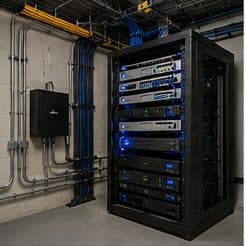
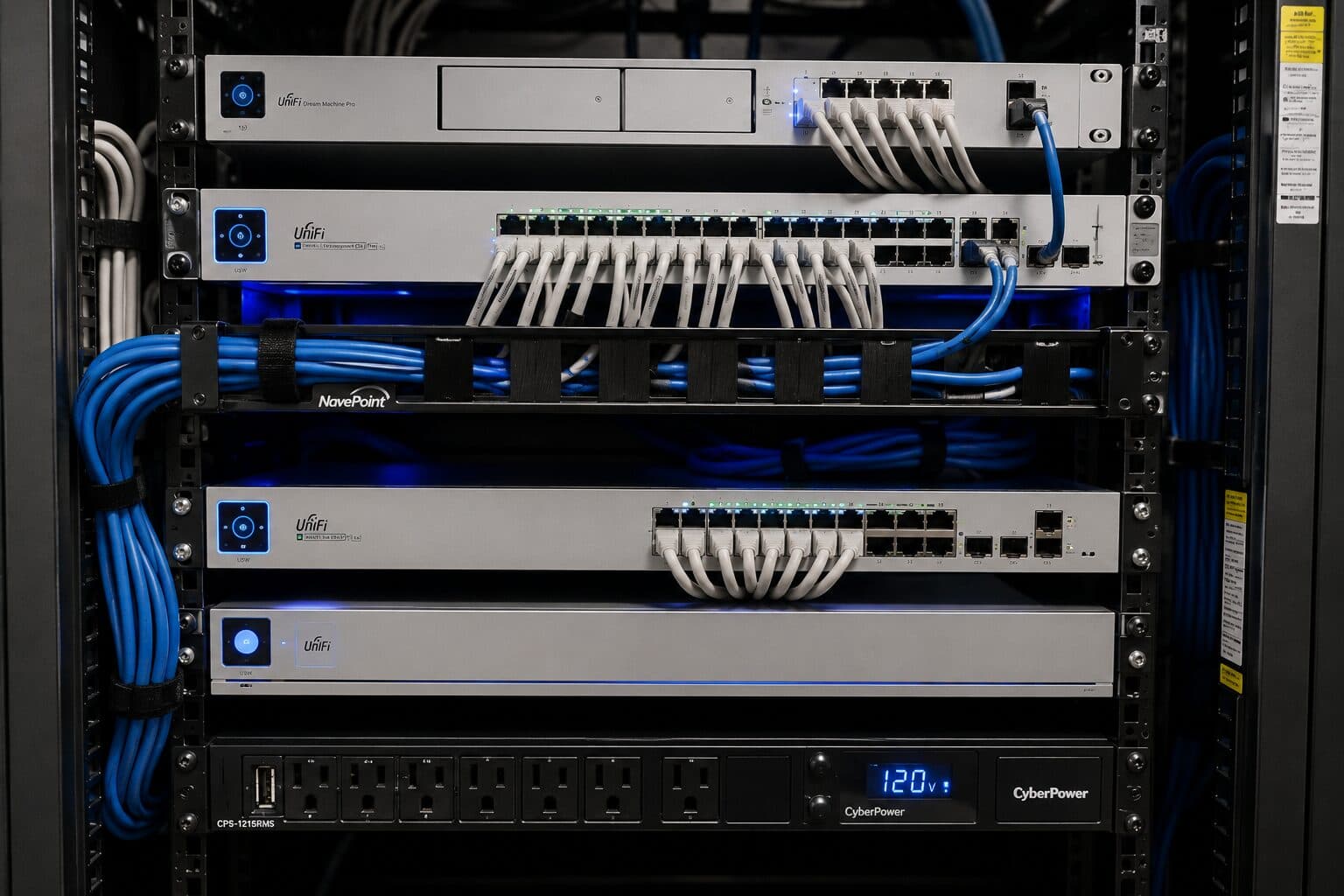
- Equipment room secured, since it holds the systems everything depends on
Line of sight, the Fresnel zone, alignment, and honest throughput
Line of sight is necessary but not sufficient. Beyond a visible clear path, the Fresnel zone — an elliptical region around the direct line — has to stay largely clear, which means the link often needs more height than 'we can see the other roof' suggests, because ground, foliage, and structures intrude on that zone. Confirming the path, and the height needed to clear it, is the first and most important step.
- Confirmed clear line of sight and Fresnel-zone clearance
- Enough mounting height to clear ground, foliage, and structures
- Directional antennas aligned precisely and mounted solidly
- Throughput specified realistically for distance and obstruction
- Band and channel chosen against local interference
- PoE power and weatherproof mounting at each end
Frequently asked questions
What changes about wireless bridge (point-to-point) in medical offices?
The operating environment does. Medical offices bring specific constraints — how the space is used, when work can happen, and what has to keep running — and those shape the wireless bridge (point-to-point) plan as much as the service's own technical requirements.
When should I use a wireless bridge instead of running cable?
When a physical run is genuinely impractical — a road, a parking lot, or a distance that would mean major trenching between two buildings. Where a cable can reasonably go, especially fiber between separately grounded structures, it is more reliable. A bridge is the right tool specifically when the gap can't be crossed physically and there is clear line of sight.
Should patient guest Wi-Fi be offered?
It is common in waiting areas, and the requirement is that it is architecturally isolated: unable to reach clinical systems, staff devices, or building systems, and rate-limited so it cannot affect anything operational. Configured that way it is a low-risk courtesy; configured as a shared flat network it is not.