Low-voltage installation for medical offices, in West University Place
Low-voltage installation for medical offices in West University Place is a three-part question: what low-voltage installation involves, what medical offices need from it, and what West University Place changes about the install. Dense established homes on small residential lots.
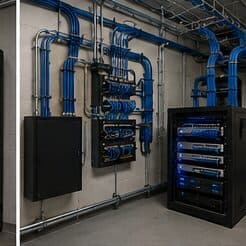
Low-voltage work covers the systems that run on cable rather than mains power: data, wireless, cameras, door access, intercoms, and audio-visual. In a new build or a fit-out these systems share pathways, share an equipment position, and increasingly share a network — so planning them together during rough-in costs far less than adding each one separately after the walls close.
Separation, access, and continuity
Three priorities dominate. Separate the networks so patient-facing guest access cannot reach clinical systems. Control access to the areas that require it, with records that show who entered and when. Plan any cutover so clinical operations are not interrupted mid-session.
Everything else — coverage quality, cable tidiness, camera placement — matters, but these three are the ones with consequences beyond inconvenience.
- Guest, staff, clinical, and building-system networks kept separate
- Access control on records, medication, and treatment areas as appropriate
- Cutovers scheduled around clinical sessions, not around installer convenience
- Wired connections for imaging and other equipment that depends on throughput
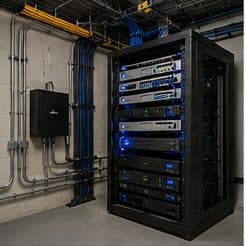
- Equipment position secured against casual access
Where low-voltage installation goes wrong — and how it's avoided
The expensive low-voltage mistakes all happen before anyone pulls cable.
- Specifying systems one at a time instead of planning them together
- Sizing the equipment room for the network only
- Missing the rough-in window and having to retrofit through closed walls
- Leaving device locations unresolved and guessing during rough-in
- Making rated penetrations without sleeves and firestopping
- Leaving cable unlabeled and unprotected between rough-in and finish
West University Place: what the location changes
In West University Place, the plan is built outward from the conditions that are actually here. Dense established homes on small residential lots. Continuous teardown-and-rebuild activity, making prewire valuable. High finish expectations with limited space for equipment positions. Each one changes where cable can run, where equipment can sit, and how coverage is shaped, which is why a walkthrough settles a West University Place scope faster than any generic estimate.
- Dense established homes on small residential lots
- Continuous teardown-and-rebuild activity, making prewire valuable
- High finish expectations with limited space for equipment positions
- Slab foundations with attic-to-interior-wall retrofit routing
- Compact footprints keeping runs short but concealment demanding
Getting it done in West University Place
Each system is commissioned on its own terms, but the low-voltage handover is the point where they are verified together.
Camera coverage in medical settings is deliberately limited in scope. Entrances, corridors leading to controlled areas, medication storage approaches, parking areas, and after-hours coverage of the perimeter are the usual placements. Treatment areas are not camera locations, and this is worth stating plainly during design so the boundary is explicit.
On site, the schedule and working method turn on conditions like these. Slab foundations with attic-to-interior-wall retrofit routing. Compact footprints keeping runs short but concealment demanding. Both shape how and when a crew can actually operate, which is why EVOTECH scopes each West University Place job from the property itself rather than assuming one approach fits every address. Coverage is stated as a service area, never an office claim, and anything about West University Place that cannot be verified is left out instead of invented.
Popular services nearby
Frequently searched near this area — the pages people look for most.
Frequently asked questions
Is low-voltage installation for medical offices different in West University Place?
The sector needs stay the same, but the install changes with the place. In West University Place, the conditions above — not the medical offices label — decide routes, mounting, and equipment placement, which is why this page pairs all three.
When should low-voltage work happen in a construction schedule?
Rough-in sits after electrical and framing and before insulation and drywall. Finish work — terminations, device mounting, and commissioning — happens after paint and ceilings. The risk is that upstream delays compress the rough-in window, so having device locations and pathway plans settled in advance is what keeps that window usable.