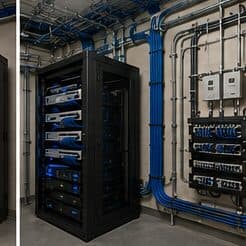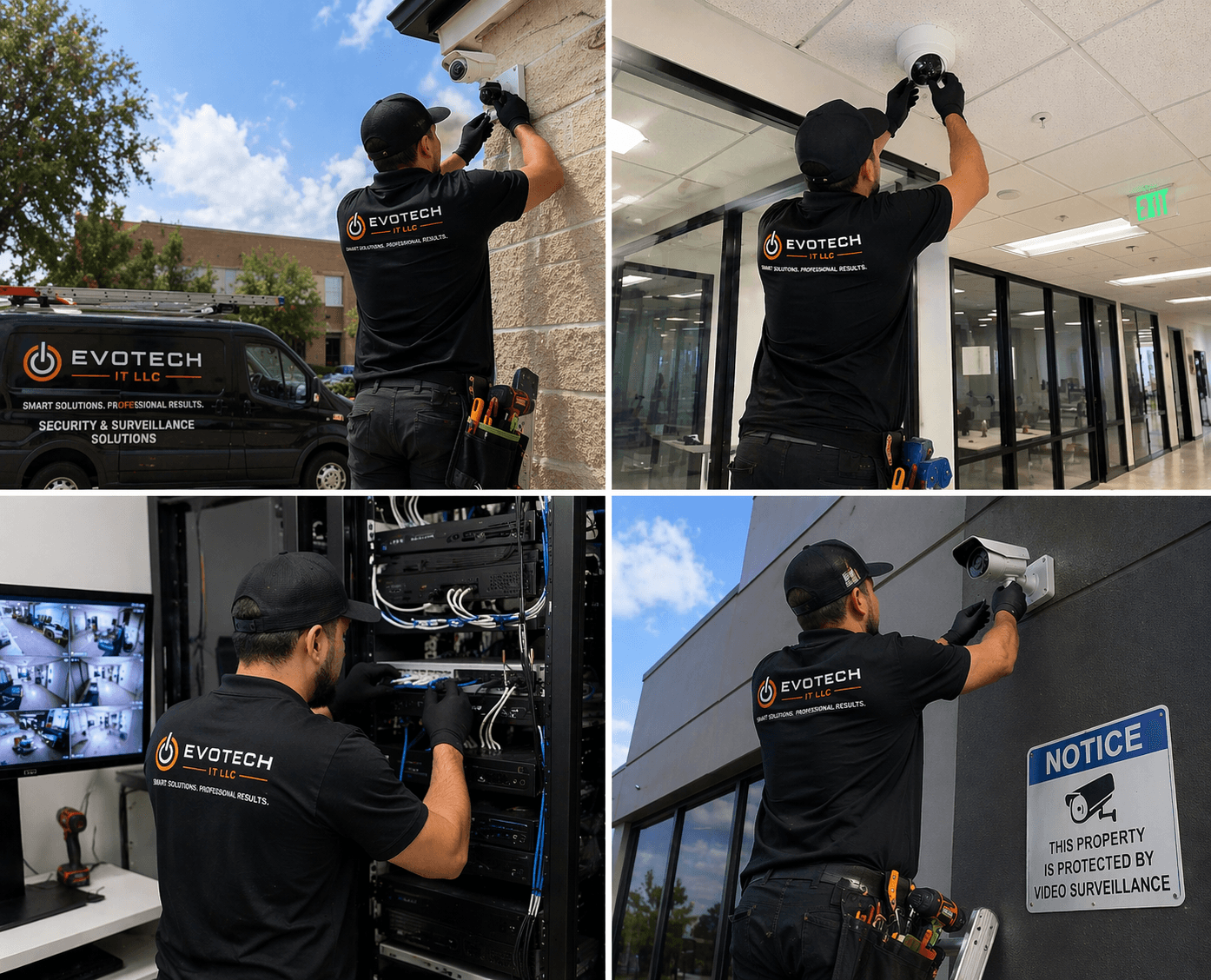
PoE camera installation for medical offices, in Tomball
PoE camera installation for medical offices in Tomball is a three-part question: what poe camera installation involves, what medical offices need from it, and what Tomball changes about the install. A historic small-town core with masonry buildings and limited pathway.
A PoE camera takes its power from the same Ethernet cable that carries its video, which removes the need for a local outlet at every mounting position. That is the entire practical appeal: one run per camera, no electrician at each soffit, and centralised power that can sit behind a UPS so the cameras stay up during a short outage.
Separation, access, and continuity
Three priorities dominate. Separate the networks so patient-facing guest access cannot reach clinical systems. Control access to the areas that require it, with records that show who entered and when. Plan any cutover so clinical operations are not interrupted mid-session.
Everything else — coverage quality, cable tidiness, camera placement — matters, but these three are the ones with consequences beyond inconvenience.
- Guest, staff, clinical, and building-system networks kept separate
- Access control on records, medication, and treatment areas as appropriate
- Cutovers scheduled around clinical sessions, not around installer convenience
- Wired connections for imaging and other equipment that depends on throughput
- Equipment position secured against casual access
What changes poe camera installation from job to job
Scope depends on the power profile as much as the camera count.
- Camera count and the class each one requires
- Whether any devices need higher-power classes for motors, heaters, or illuminators
- Cable distance to each position
- Switch selection and whether existing switching has budget available
- Exterior penetrations, junction boxes, and weather sealing
- UPS capacity for the desired runtime
- Access requirements for elevated mounting
Tomball: what the location changes
A historic small-town core with masonry buildings and limited pathway. In Tomball, that is where the plan begins, because it changes cable paths, device placement, and access-point counts before anything else does. Growing retail and medical buildouts with suspended-grid ceilings and tenant-improvement conditions. Larger properties and outbuildings toward the northern edge, bringing longer runs. None of these are generic checklist items — each moves the design in a direction a citywide assumption would miss, and the honest recommendation always depends on what this particular property allows.
- A historic small-town core with masonry buildings and limited pathway
- Growing retail and medical buildouts with suspended-grid ceilings and tenant-improvement conditions
- Larger properties and outbuildings toward the northern edge, bringing longer runs
- Slab-foundation residential across established and newer subdivisions
- Gulf Coast humidity requiring rated exterior housings and sealed penetrations
Getting it done in Tomball
The meaningful PoE test is under peak load after dark, because that is the condition that exposes budget problems.
Camera coverage in medical settings is deliberately limited in scope. Entrances, corridors leading to controlled areas, medication storage approaches, parking areas, and after-hours coverage of the perimeter are the usual placements. Treatment areas are not camera locations, and this is worth stating plainly during design so the boundary is explicit.
On site, the schedule and working method turn on conditions like these. Slab-foundation residential across established and newer subdivisions. Gulf Coast humidity requiring rated exterior housings and sealed penetrations. Both shape how and when a crew can actually operate, which is why EVOTECH scopes each Tomball job from the property itself rather than assuming one approach fits every address. Coverage is stated as a service area, never an office claim, and anything about Tomball that cannot be verified is left out instead of invented.
Frequently asked questions
Is poe camera installation for medical offices different in Tomball?
The sector needs stay the same, but the install changes with the place. In Tomball, the conditions above — not the medical offices label — decide routes, mounting, and equipment placement, which is why this page pairs all three.
Why do cameras reboot at night but work fine during the day?
Almost always PoE budget. Infrared illuminators engage after dark and the total draw rises, pushing the switch past its budget. It presents as intermittent camera dropouts and gets misdiagnosed as a network fault. The fix is a switch with sufficient budget and headroom, calculated from peak draw rather than idle.