Network cabling for medical offices, in The Woodlands
Network cabling for medical offices in The Woodlands is a three-part question: what network cabling involves, what medical offices need from it, and what The Woodlands changes about the install. Mature tree cover on many residential lots, attenuating outdoor wireless signal and generating constant motion in camera scenes.
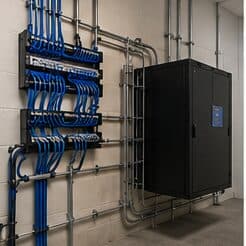
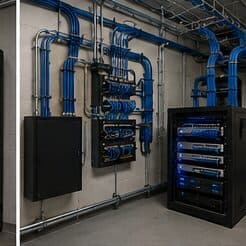
Network cabling is the permanent copper and fiber pathway between a building's equipment room and every device location. Done properly it is a structured system — horizontal runs from a patch panel out to labeled outlets, each one under the 90-metre permanent-link limit, each one tested and documented. Done casually it is a bundle of unlabeled patch cords stapled to a joist, and every future change costs someone an afternoon of tracing.
Cameras and access in a clinical setting
Camera coverage in medical settings is deliberately limited in scope. Entrances, corridors leading to controlled areas, medication storage approaches, parking areas, and after-hours coverage of the perimeter are the usual placements. Treatment areas are not camera locations, and this is worth stating plainly during design so the boundary is explicit.
Access control usually carries more weight than cameras here, because the practical requirement is controlling and evidencing entry to specific areas rather than recording activity generally. Door records showing who entered a records room and when answer the questions that actually get asked.
Where cameras and access control are integrated, a door event can be reviewed alongside footage of the corridor approach — which is often the useful combination, and does not require a camera inside the controlled area itself.
- Entrances, corridors to controlled areas, and medication storage approaches
- No cameras in treatment or examination areas
- Access records as the primary evidence for controlled-area entry
- Integration so door events can be reviewed with corridor footage
- Exterior and parking coverage for after-hours
What drives the cost of network cabling here
Cabling scope is priced from conditions, not from a per-outlet number, which is why a walkthrough or a good set of photos changes an estimate more than any other input. The largest single driver is usually whether the pathway already exists.
- Total run count and average run length
- Whether existing tray, conduit, or sleeves can be reused
- Ceiling and wall construction, including hard-lid areas requiring cut and patch
- Category of cable specified and whether shielding is required
- Depth of testing and documentation requested
- Working hours: occupied space and after-hours windows extend the schedule
The Woodlands: what the location changes
In The Woodlands, the plan is built outward from the conditions that are actually here. Mature tree cover on many residential lots, attenuating outdoor wireless signal and generating constant motion in camera scenes. Corporate and professional office stock with meeting-room density driving wireless capacity requirements. Larger residential lots with detached structures and outbuildings beyond practical house-coverage range. Each one changes where cable can run, where equipment can sit, and how coverage is shaped, which is why a walkthrough settles a The Woodlands scope faster than any generic estimate.
- Mature tree cover on many residential lots, attenuating outdoor wireless signal and generating constant motion in camera scenes
- Corporate and professional office stock with meeting-room density driving wireless capacity requirements
- Larger residential lots with detached structures and outbuildings beyond practical house-coverage range
- Master-planned development producing relatively consistent, newer commercial construction with usable pathway
- Wooded exterior camera positions requiring careful framing to avoid constant vegetation-triggered motion events
Getting it done in The Woodlands
Testing is what separates a cabling installation from a cable pull. A basic continuity or wire-map check confirms the pairs land in the right order; it says nothing about whether the link will carry its rated bandwidth. Certification testing against the relevant TIA channel or permanent-link limits measures insertion loss, return loss, near-end crosstalk, and delay skew, and produces a per-port record.
A medical office has a clear division between public, staff, and controlled areas, and the technology follows that division. Waiting areas need guest connectivity that reaches nothing internal. Treatment rooms need reliable connectivity for clinical systems. Records areas and medication storage need controlled access with a usable audit trail.
Getting The Woodlands work done means planning around the site as it actually is. Master-planned development producing relatively consistent, newer commercial construction with usable pathway. Wooded exterior camera positions requiring careful framing to avoid constant vegetation-triggered motion events. Both matter as much as the design to how and when the work happens. The scope is drawn from the real property, the coverage is stated as a service area rather than an office, and unverifiable specifics about The Woodlands are kept off the page on purpose.
Popular services nearby
Frequently searched near this area — the pages people look for most.
Frequently asked questions
Is network cabling for medical offices different in The Woodlands?
The sector needs stay the same, but the install changes with the place. In The Woodlands, the conditions above — not the medical offices label — decide routes, mounting, and equipment placement, which is why this page pairs all three.
How long can a single network cable run be?
The fixed cable between patch panel and outlet is limited to 90 metres, with patch cords at each end bringing the total channel to 100 metres. Beyond that, the answer is not a longer cable — it is either an intermediate equipment location or a fiber link to a secondary switch.