Ubiquiti UniFi installation for medical offices, in Rosenberg
Ubiquiti UniFi installation for medical offices in Rosenberg is a three-part question: what ubiquiti unifi installation involves, what medical offices need from it, and what Rosenberg changes about the install. Warehousing and light-industrial buildings along the highway corridor, with metal construction that reflects wireless signal and needs proper cable support.
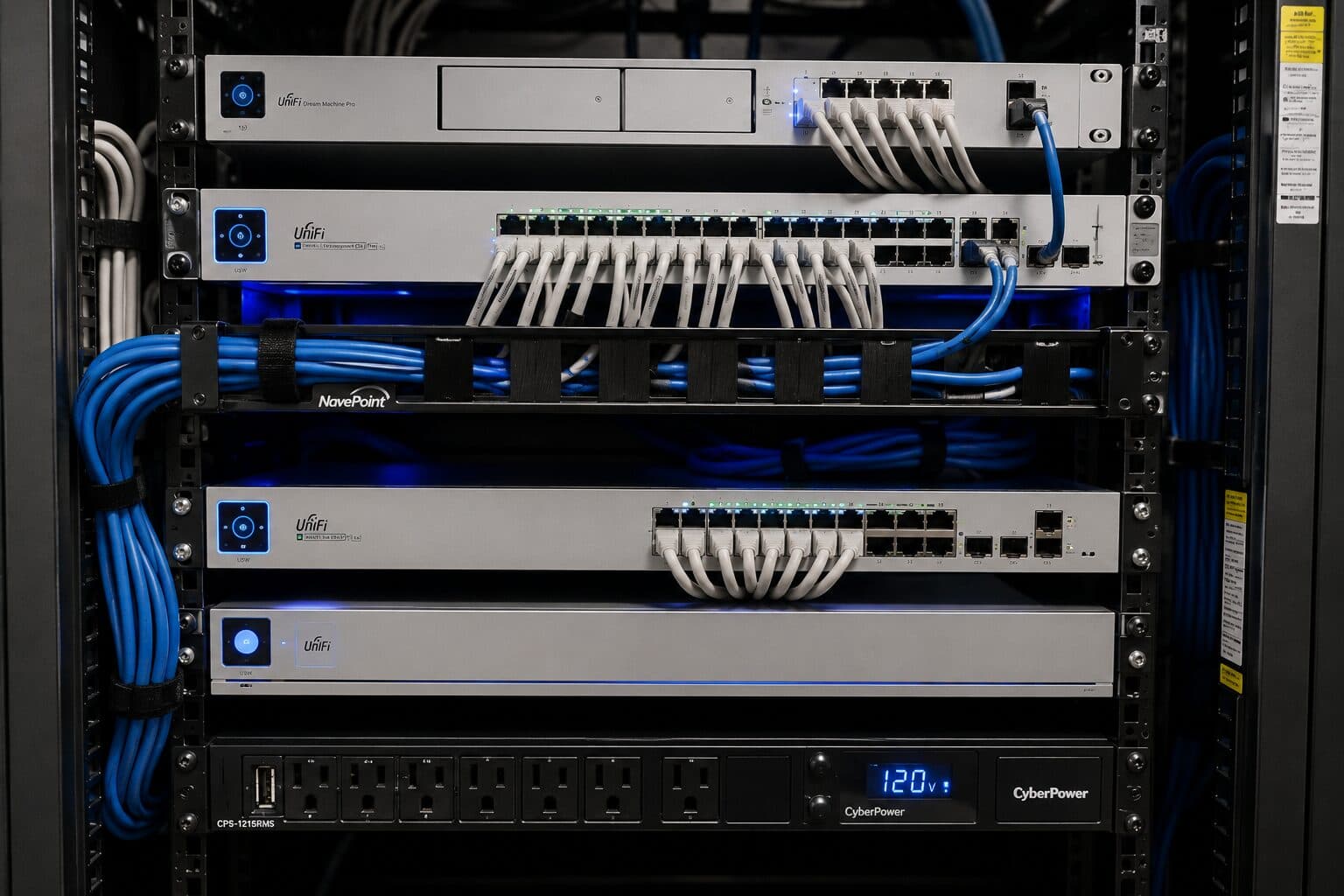
A UniFi deployment puts the gateway, switching, wireless, and often cameras and door access under one controller. The practical benefit is operational rather than raw performance: one interface for network configuration, client visibility, firmware updates, and camera review, instead of separate systems that each need their own knowledge.
Cameras and access in a clinical setting
Camera coverage in medical settings is deliberately limited in scope. Entrances, corridors leading to controlled areas, medication storage approaches, parking areas, and after-hours coverage of the perimeter are the usual placements. Treatment areas are not camera locations, and this is worth stating plainly during design so the boundary is explicit.
Access control usually carries more weight than cameras here, because the practical requirement is controlling and evidencing entry to specific areas rather than recording activity generally. Door records showing who entered a records room and when answer the questions that actually get asked.
Where cameras and access control are integrated, a door event can be reviewed alongside footage of the corridor approach — which is often the useful combination, and does not require a camera inside the controlled area itself.
- Entrances, corridors to controlled areas, and medication storage approaches
- No cameras in treatment or examination areas
- Access records as the primary evidence for controlled-area entry
- Integration so door events can be reviewed with corridor footage
- Exterior and parking coverage for after-hours
What changes ubiquiti unifi installation from job to job
Scope moves with device count and the amount of configuration the site needs.
- Number of access points, cameras, switches, and door devices
- Number of network segments and the complexity of the rules between them
- Cabling required to reach each device position
- Camera resolution and retention target, which set storage
- Whether the controller runs on dedicated hardware
- Whether an existing network must be migrated with minimal downtime
- Remote-access requirements and who needs which level of visibility
Rosenberg: what the location changes
In Rosenberg, the plan is built outward from the conditions that are actually here. Warehousing and light-industrial buildings along the highway corridor, with metal construction that reflects wireless signal and needs proper cable support. An older rail-town commercial core with masonry buildings and limited existing pathway. Newer suburban subdivisions on slab foundations following the regional attic-routing pattern. Each one changes where cable can run, where equipment can sit, and how coverage is shaped, which is why a walkthrough settles a Rosenberg scope faster than any generic estimate.
- Warehousing and light-industrial buildings along the highway corridor, with metal construction that reflects wireless signal and needs proper cable support
- An older rail-town commercial core with masonry buildings and limited existing pathway
- Newer suburban subdivisions on slab foundations following the regional attic-routing pattern
- Dust exposure in industrial and distribution environments, affecting rack and equipment placement
- Gulf Coast humidity and driven-rain events requiring rated exterior housings and sealed penetrations
Getting it done in Rosenberg
Validation covers the network design as well as the radio coverage, because segmentation that was configured but not tested is not yet segmentation.
A medical office has a clear division between public, staff, and controlled areas, and the technology follows that division. Waiting areas need guest connectivity that reaches nothing internal. Treatment rooms need reliable connectivity for clinical systems. Records areas and medication storage need controlled access with a usable audit trail.
Getting Rosenberg work done means planning around the site as it actually is. Dust exposure in industrial and distribution environments, affecting rack and equipment placement. Gulf Coast humidity and driven-rain events requiring rated exterior housings and sealed penetrations. Both matter as much as the design to how and when the work happens. The scope is drawn from the real property, the coverage is stated as a service area rather than an office, and unverifiable specifics about Rosenberg are kept off the page on purpose.
Frequently asked questions
Is ubiquiti unifi installation for medical offices different in Rosenberg?
The sector needs stay the same, but the install changes with the place. In Rosenberg, the conditions above — not the medical offices label — decide routes, mounting, and equipment placement, which is why this page pairs all three.
Is UniFi the right choice for a small business?
It suits sites that want proper segmentation, decent wireless, and cameras under one interface without employing a network administrator. The tradeoff is committing to one vendor's ecosystem. A mixed-vendor design gives more freedom to pick the best component for each role; the single-vendor version is easier to live with day to day. Both are defensible — it is worth choosing on purpose.