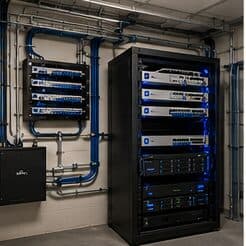
TV mounting for medical offices, in Pearland
TV mounting for medical offices in Pearland is a three-part question: what tv mounting involves, what medical offices need from it, and what Pearland changes about the install. Newer residential subdivisions with wide floor plans and builder-installed structured cable of variable quality.
The second decision is height, and it is the one most often regretted. A display mounted above a fireplace usually sits well above comfortable seated viewing angle, which means looking up for the length of anything watched there. Sometimes the fireplace is the only option; it is worth being clear that it is a compromise before the holes are drilled.
Segmentation and clinical connectivity
Clinical systems belong on their own segment, separate from staff general-purpose devices, separate again from patient guest access, and separate from building systems such as cameras and door controllers. This limits what any single compromised device can reach and makes the network far easier to reason about when something misbehaves.
For clinical equipment that moves large files — imaging in particular — wired connections are worth insisting on where the equipment supports them. Wireless is fine for tablets and general staff use, but a modality pushing studies across a congested wireless cell produces exactly the kind of intermittent slowness that is difficult to diagnose and disruptive to a clinic day.
Guest access in a waiting area should be isolated from everything internal and rate-limited. It is a courtesy, and it should be architecturally incapable of touching anything clinical.
- Clinical, staff, guest, and building-system traffic on separate segments
- Wired connections for imaging and other high-throughput clinical equipment
- Waiting-area guest access isolated and capped
- Access points placed for coverage in treatment rooms without relying on corridor spill
- Equipment room secured, since it holds the systems everything depends on
Where tv mounting goes wrong — and how it's avoided
Mounting mistakes range from cosmetic to genuinely unsafe.
- Anchoring an articulating mount into drywall or a single stud
- Treating metal studs like wood framing
- Setting masonry anchors into mortar joints
- Running a standard power cord inside the wall
- Mounting before running signal cable, leaving no route afterwards
- Choosing height for the wall's convenience rather than the seating
- Using indoor hardware on a covered patio and watching it corrode
Pearland: what the location changes
What separates a Pearland scope from the rest of the city is concrete and local. Newer residential subdivisions with wide floor plans and builder-installed structured cable of variable quality. Expanding medical office space with controlled-area access requirements and clinical scheduling constraints. Food-service commercial space with kitchen environments and narrow after-hours working windows. That short list is what actually drives the design in this pocket, and it is why photographs or a brief site visit beat a floor plan — the plan follows the building's real constraints, not the neighborhood name on the map.
- Newer residential subdivisions with wide floor plans and builder-installed structured cable of variable quality
- Expanding medical office space with controlled-area access requirements and clinical scheduling constraints
- Food-service commercial space with kitchen environments and narrow after-hours working windows
- Slab-on-grade residential foundations making attic routing the standard retrofit path
- Newer commercial construction generally offering suspended-grid ceilings and usable pathway
Getting it done in Pearland
Verification is mechanical and visual, done before the installation is called finished.
Work in treatment areas is scheduled around patient sessions, which typically means early mornings, evenings, or non-clinical days. Corridors and public areas are more flexible but still need containment and clean working practice.
Getting Pearland work done means planning around the site as it actually is. Slab-on-grade residential foundations making attic routing the standard retrofit path. Newer commercial construction generally offering suspended-grid ceilings and usable pathway. Both matter as much as the design to how and when the work happens. The scope is drawn from the real property, the coverage is stated as a service area rather than an office, and unverifiable specifics about Pearland are kept off the page on purpose.
Popular services nearby
Frequently searched near this area — the pages people look for most.
Frequently asked questions
Is tv mounting for medical offices different in Pearland?
The sector needs stay the same, but the install changes with the place. In Pearland, the conditions above — not the medical offices label — decide routes, mounting, and equipment placement, which is why this page pairs all three.
Can a TV be mounted on a metal-stud wall?
Yes, but not with wood-stud technique. Metal studs are thin and will not hold lag bolts under sustained load. The reliable approaches are plywood backing behind the drywall — easy during construction, more involved afterwards — or an anchoring system made for metal studs and rated for the display weight. This matters most with articulating arms, which multiply the load considerably.