Commercial IT solutions for medical offices, in Pasadena
Commercial IT solutions for medical offices in Pasadena is a three-part question: what commercial it solutions involves, what medical offices need from it, and what Pasadena changes about the install. Older industrial and service-corridor commercial stock, with rugged operational environments harder on equipment than office settings.
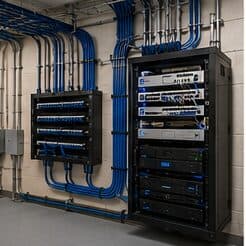
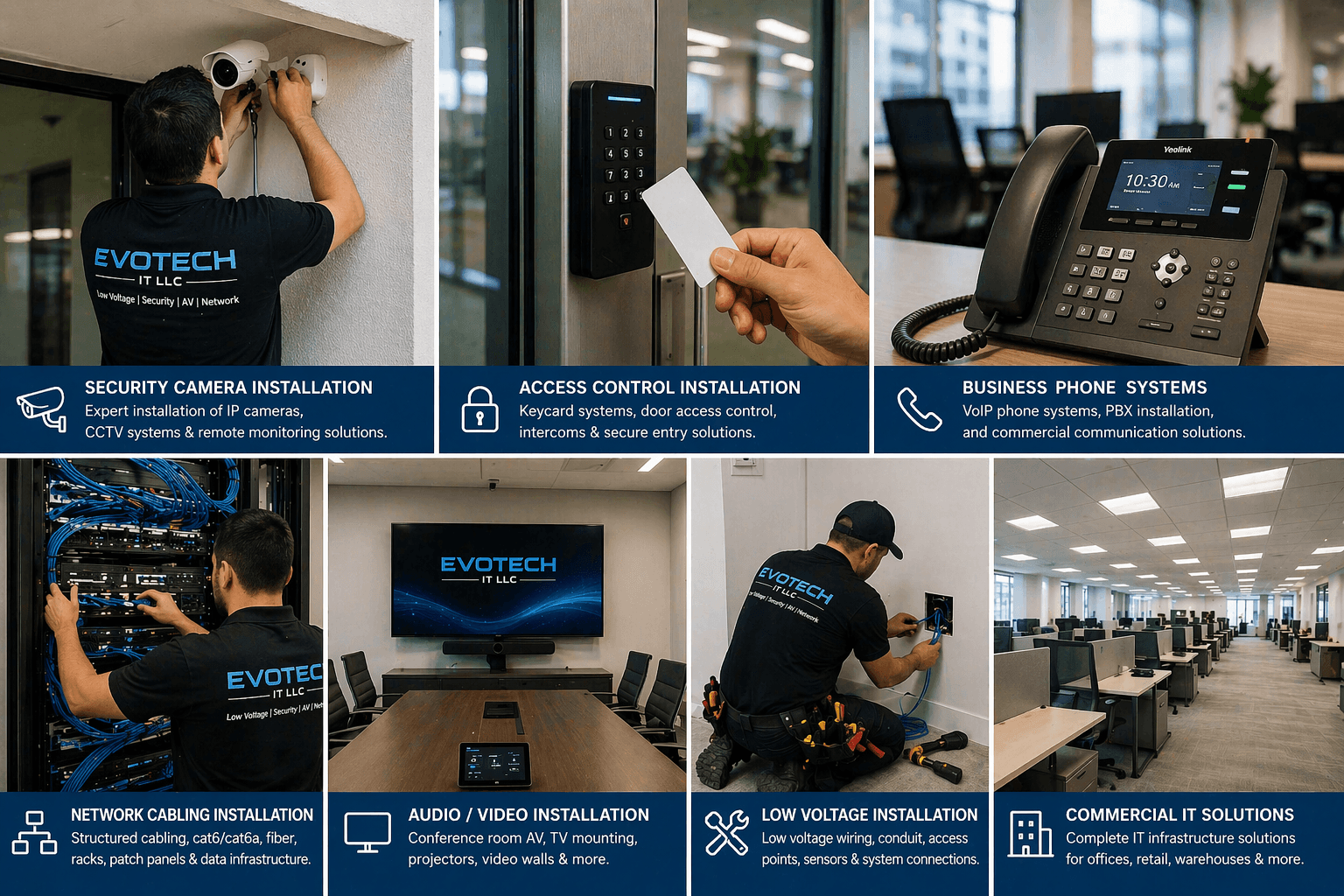
A business does not need a network, then some cameras, then a phone system, then Wi-Fi, each chosen by a different vendor at a different time. It needs those systems designed to work together on shared infrastructure, sized for how the business will grow, and delivered so one party is accountable for the whole thing working. That is what commercial IT solutions means here: the full low-voltage and network stack — structured cabling, managed switching and Wi-Fi, cameras, access control, and phones — planned as a single system rather than assembled from disconnected projects.
Controlled areas and uninterruptible systems
A medical office has a clear division between public, staff, and controlled areas, and the technology follows that division. Waiting areas need guest connectivity that reaches nothing internal. Treatment rooms need reliable connectivity for clinical systems. Records areas and medication storage need controlled access with a usable audit trail.
The other defining characteristic is that some systems cannot simply be taken down for an afternoon. Practice management, imaging, and anything connected to patient scheduling has a real cost when interrupted, so cutover planning matters more here than in most commercial environments.
- Distinct public, staff, and controlled zones with different requirements
- Clinical systems that cannot tolerate unplanned interruption
- Records and medication areas requiring access control with audit records
- Patient scheduling constraining when work can happen in treatment areas
Where commercial it solutions goes wrong — and how it's avoided
Commercial technology fails on coordination far more than on components.
- Buying each system separately and inheriting a flat, fragile network
- Cabling for one system at a time rather than a shared backbone
- Sizing infrastructure to today and rebuilding at the next hire
- No accountable party, leaving the business to integrate its own vendors
- Relocating without a coordinated cutover and losing days
- Building each site differently, so support never gets consistent
Pasadena: what the location changes
In Pasadena, the plan is built outward from the conditions that are actually here. Older industrial and service-corridor commercial stock, with rugged operational environments harder on equipment than office settings. Metal and mixed-construction buildings requiring proper cable support and camera housings rated for the environment. Established residential neighbourhoods predating structured wiring, needing genuine retrofit. Each one changes where cable can run, where equipment can sit, and how coverage is shaped, which is why a walkthrough settles a Pasadena scope faster than any generic estimate.
- Older industrial and service-corridor commercial stock, with rugged operational environments harder on equipment than office settings
- Metal and mixed-construction buildings requiring proper cable support and camera housings rated for the environment
- Established residential neighbourhoods predating structured wiring, needing genuine retrofit
- Coastal-adjacent humidity and driven rain requiring durable exterior sealing
- Network rooms that grew organically and need remediation rather than expansion
Getting it done in Pasadena
A coordinated system is verified as a whole, not one component at a time.
Clinical systems belong on their own segment, separate from staff general-purpose devices, separate again from patient guest access, and separate from building systems such as cameras and door controllers. This limits what any single compromised device can reach and makes the network far easier to reason about when something misbehaves.
Getting Pasadena work done means planning around the site as it actually is. Coastal-adjacent humidity and driven rain requiring durable exterior sealing. Network rooms that grew organically and need remediation rather than expansion. Both matter as much as the design to how and when the work happens. The scope is drawn from the real property, the coverage is stated as a service area rather than an office, and unverifiable specifics about Pasadena are kept off the page on purpose.
Frequently asked questions
Is commercial it solutions for medical offices different in Pasadena?
The sector needs stay the same, but the install changes with the place. In Pasadena, the conditions above — not the medical offices label — decide routes, mounting, and equipment placement, which is why this page pairs all three.
How is this different from just hiring separate installers?
Coordination and accountability. Separate installers each optimise their own system, which is how a business ends up with everything on one flat network, cabling that suits nobody, and no one able to say why something does not work. A coordinated design puts every system on shared, segmented infrastructure and gives you one party accountable for the whole thing working — which is usually cheaper over the life of the fit-out, not just simpler.