Commercial IT solutions for medical offices, in Humble
Commercial IT solutions for medical offices in Humble is a three-part question: what commercial it solutions involves, what medical offices need from it, and what Humble changes about the install. A retail and commercial hub with a broad mix of building ages.
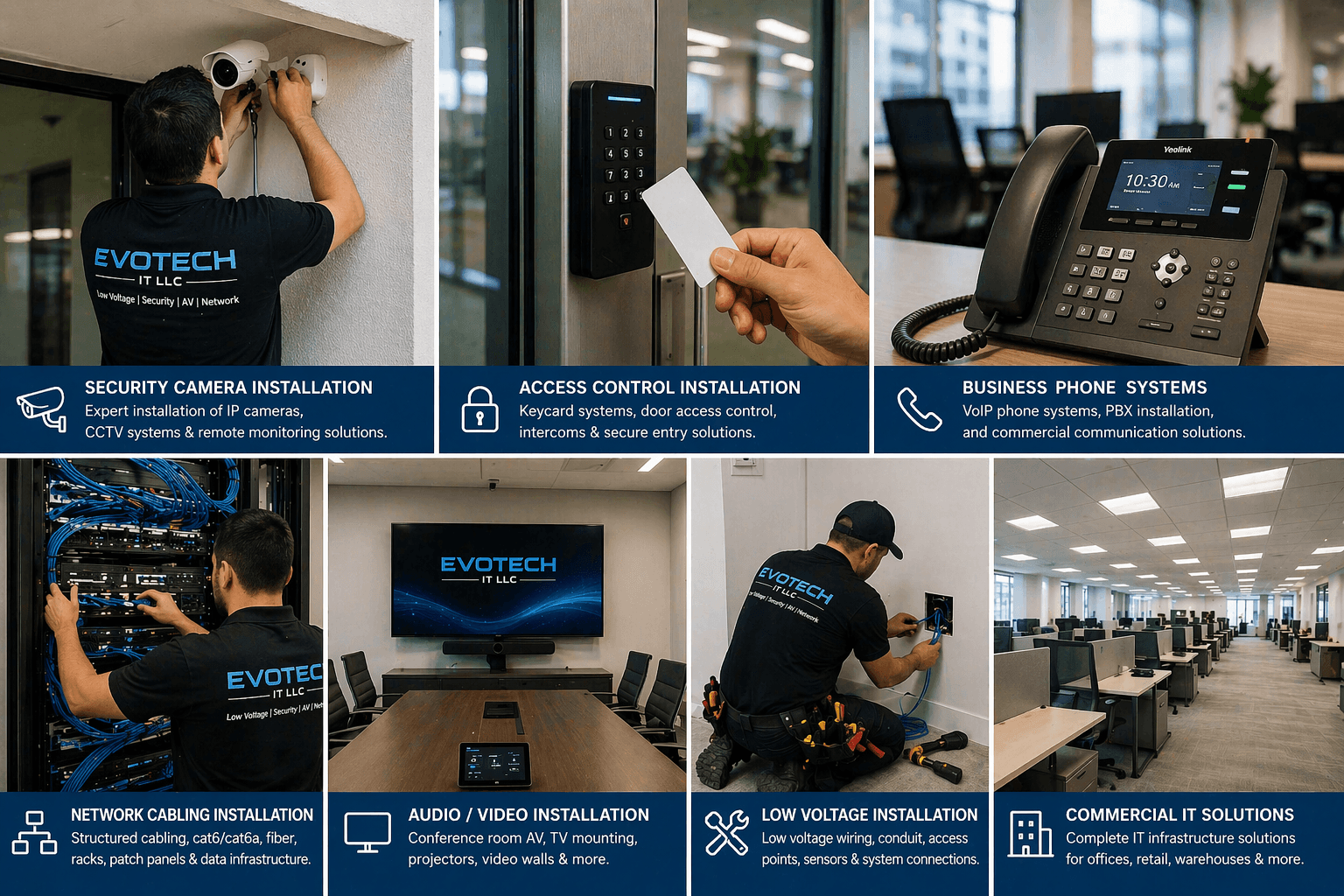
A business does not need a network, then some cameras, then a phone system, then Wi-Fi, each chosen by a different vendor at a different time. It needs those systems designed to work together on shared infrastructure, sized for how the business will grow, and delivered so one party is accountable for the whole thing working. That is what commercial IT solutions means here: the full low-voltage and network stack — structured cabling, managed switching and Wi-Fi, cameras, access control, and phones — planned as a single system rather than assembled from disconnected projects.
Segmentation and clinical connectivity
Clinical systems belong on their own segment, separate from staff general-purpose devices, separate again from patient guest access, and separate from building systems such as cameras and door controllers. This limits what any single compromised device can reach and makes the network far easier to reason about when something misbehaves.
For clinical equipment that moves large files — imaging in particular — wired connections are worth insisting on where the equipment supports them. Wireless is fine for tablets and general staff use, but a modality pushing studies across a congested wireless cell produces exactly the kind of intermittent slowness that is difficult to diagnose and disruptive to a clinic day.
Guest access in a waiting area should be isolated from everything internal and rate-limited. It is a courtesy, and it should be architecturally incapable of touching anything clinical.
- Clinical, staff, guest, and building-system traffic on separate segments
- Wired connections for imaging and other high-throughput clinical equipment
- Waiting-area guest access isolated and capped
- Access points placed for coverage in treatment rooms without relying on corridor spill
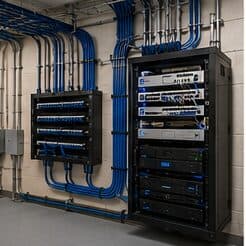
- Equipment room secured, since it holds the systems everything depends on
What drives the cost of commercial it solutions here
Breadth, site count, and continuity requirements drive the cost more than any single system.
- Number of systems and the integration between them
- Site size and count
- Continuity provision: UPS, failover, and equipment-room build
- Growth headroom designed in
- Migration of existing systems versus new build
- Whether ongoing management is included
Humble: what the location changes
In Humble, the plan is built outward from the conditions that are actually here. A retail and commercial hub with a broad mix of building ages. Warehousing and distribution requiring aisle coverage and longer runs. Older commercial stock needing pathway remediation and rack cleanup. Each one changes where cable can run, where equipment can sit, and how coverage is shaped, which is why a walkthrough settles a Humble scope faster than any generic estimate.
- A retail and commercial hub with a broad mix of building ages
- Warehousing and distribution requiring aisle coverage and longer runs
- Older commercial stock needing pathway remediation and rack cleanup
- Retail point-of-sale environments requiring network segmentation
- Slab-foundation residential across established and newer neighbourhoods
Getting it done in Humble
A coordinated system is verified as a whole, not one component at a time.
Work in treatment areas is scheduled around patient sessions, which typically means early mornings, evenings, or non-clinical days. Corridors and public areas are more flexible but still need containment and clean working practice.
Getting Humble work done means planning around the site as it actually is. Retail point-of-sale environments requiring network segmentation. Slab-foundation residential across established and newer neighbourhoods. Both matter as much as the design to how and when the work happens. The scope is drawn from the real property, the coverage is stated as a service area rather than an office, and unverifiable specifics about Humble are kept off the page on purpose.
Frequently asked questions
Is commercial it solutions for medical offices different in Humble?
The sector needs stay the same, but the install changes with the place. In Humble, the conditions above — not the medical offices label — decide routes, mounting, and equipment placement, which is why this page pairs all three.
How is this different from just hiring separate installers?
Coordination and accountability. Separate installers each optimise their own system, which is how a business ends up with everything on one flat network, cabling that suits nobody, and no one able to say why something does not work. A coordinated design puts every system on shared, segmented infrastructure and gives you one party accountable for the whole thing working — which is usually cheaper over the life of the fit-out, not just simpler.