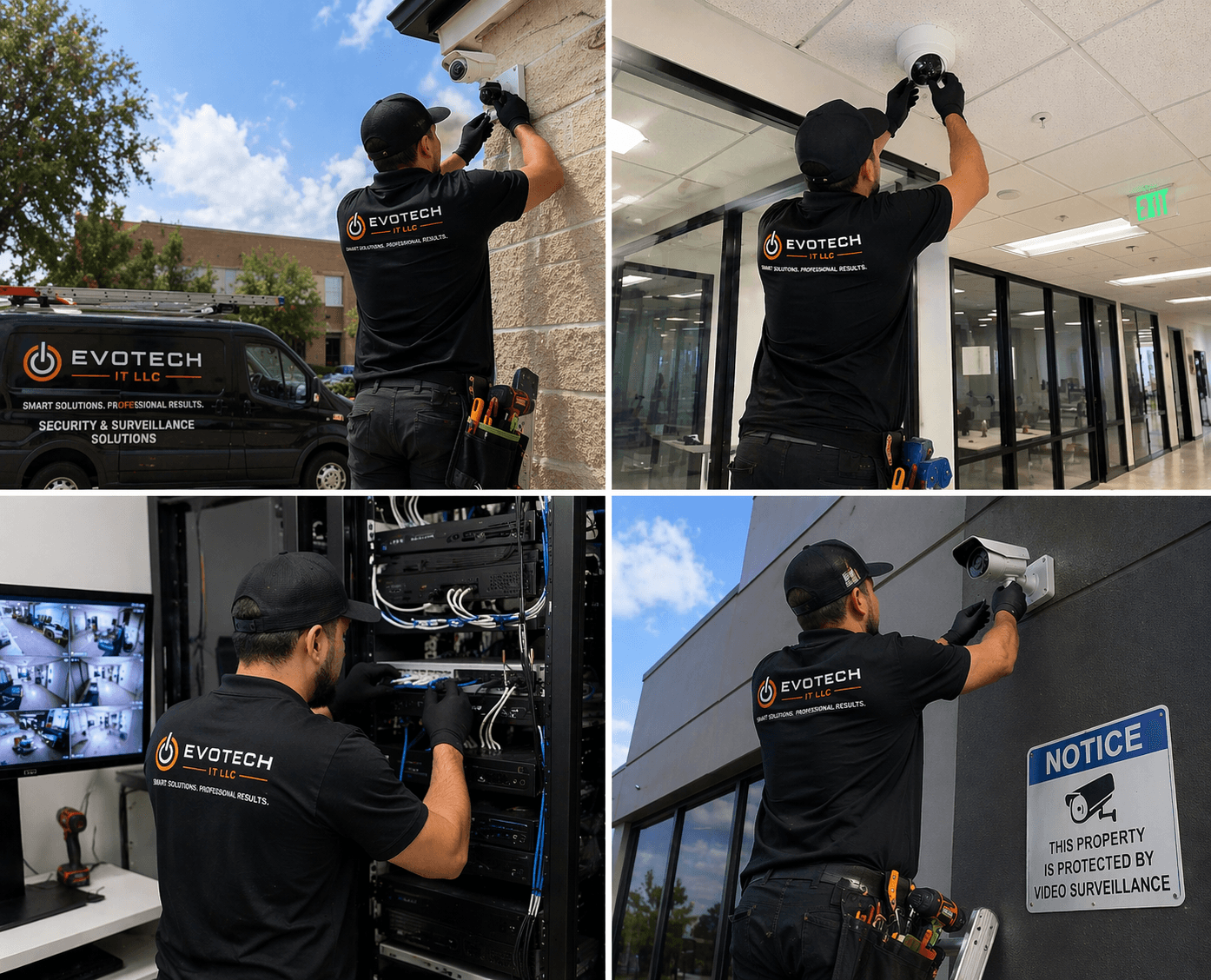
Security-camera installation for medical offices, in Houston
Security-camera installation for medical offices in Houston is a three-part question: what security-camera installation involves, what medical offices need from it, and what Houston changes about the install. Building stock spanning multiple construction eras within short distances, producing very different ceiling and pathway conditions.
That number is what determines lens choice and mounting distance. A high-resolution camera aimed at a wide area spreads its pixels thin; the same camera aimed at a doorway concentrates them. This is why a well-planned four-camera system regularly outperforms a poorly planned twelve-camera one, and why 'more megapixels' does not by itself produce usable footage.
Segmentation and clinical connectivity
Clinical systems belong on their own segment, separate from staff general-purpose devices, separate again from patient guest access, and separate from building systems such as cameras and door controllers. This limits what any single compromised device can reach and makes the network far easier to reason about when something misbehaves.
For clinical equipment that moves large files — imaging in particular — wired connections are worth insisting on where the equipment supports them. Wireless is fine for tablets and general staff use, but a modality pushing studies across a congested wireless cell produces exactly the kind of intermittent slowness that is difficult to diagnose and disruptive to a clinic day.
Guest access in a waiting area should be isolated from everything internal and rate-limited. It is a courtesy, and it should be architecturally incapable of touching anything clinical.
- Clinical, staff, guest, and building-system traffic on separate segments
- Wired connections for imaging and other high-throughput clinical equipment
- Waiting-area guest access isolated and capped
- Access points placed for coverage in treatment rooms without relying on corridor spill
- Equipment room secured, since it holds the systems everything depends on
What changes security-camera installation from job to job
Camera scope depends on objectives and access more than on property size.
- Number of areas and the objective for each
- Distance from each camera position to its target area
- Indoor, covered exterior, or fully exposed mounting
- Cable routing difficulty, including exterior penetrations and soffit access
- Retention target in days, which drives storage
- Resolution and frame rate, which also drive storage
- Lift or ladder requirements for high mounting positions
- Remote-access requirements and who needs viewing rights
Houston: what the location changes
What separates a Houston scope from the rest of the city is concrete and local. Building stock spanning multiple construction eras within short distances, producing very different ceiling and pathway conditions. Slab-on-grade foundations dominate residential construction, which pushes retrofit cable routes into the attic rather than under the floor. Gulf Coast humidity and heavy rainfall events make exterior equipment sealing and drip-loop practice a routine requirement rather than an optional detail. That short list is what actually drives the design in this pocket, and it is why photographs or a brief site visit beat a floor plan — the plan follows the building's real constraints, not the neighborhood name on the map.
- Building stock spanning multiple construction eras within short distances, producing very different ceiling and pathway conditions
- Slab-on-grade foundations dominate residential construction, which pushes retrofit cable routes into the attic rather than under the floor
- Gulf Coast humidity and heavy rainfall events make exterior equipment sealing and drip-loop practice a routine requirement rather than an optional detail
- Summer attic temperatures constrain the working window for residential retrofit and rooftop-adjacent work
- Mixed land-use patterns place commercial, light industrial, and residential structures adjacent to each other, so neighbouring buildings often need entirely different approaches
Getting it done in Houston
A camera system is commissioned by looking at its recordings, not its live view. Live video on a monitor at midday tells you very little about what the recorded file will show at nine in the evening.
Work in treatment areas is scheduled around patient sessions, which typically means early mornings, evenings, or non-clinical days. Corridors and public areas are more flexible but still need containment and clean working practice.
Getting Houston work done means planning around the site as it actually is. Summer attic temperatures constrain the working window for residential retrofit and rooftop-adjacent work. Mixed land-use patterns place commercial, light industrial, and residential structures adjacent to each other, so neighbouring buildings often need entirely different approaches. Both matter as much as the design to how and when the work happens. The scope is drawn from the real property, the coverage is stated as a service area rather than an office, and unverifiable specifics about Houston are kept off the page on purpose.
Popular services nearby
Frequently searched near this area — the pages people look for most.
Frequently asked questions
Is security-camera installation for medical offices different in Houston?
The sector needs stay the same, but the install changes with the place. In Houston, the conditions above — not the medical offices label — decide routes, mounting, and equipment placement, which is why this page pairs all three.
How many cameras does a property need?
Count objectives, not walls. Each area needs a stated purpose — detect activity, recognise a known person, or identify a stranger — and the camera serving it is chosen for that purpose. A property with four well-framed cameras at the points that matter usually produces more useful footage than one with twelve wide shots covering everything approximately.