Why this page exists
Gate & license-plate cameras for medical offices is shaped by how the space is used, not just by the service itself. Medical offices bring their own operating constraints, and this page pairs what gate & license-plate cameras actually involves with what that environment changes about it.
Watching a gate or driveway and reading the license plates that come through it are two different objectives, and they usually need two different cameras. An overview camera shows the scene — who arrived, what happened — with a wide, well-lit view. A license-plate camera is tuned narrowly for one thing: a fast shutter to freeze a moving plate, a tight field of view and angle aimed at where plates appear, and controlled infrared so the reflective plate is legible at night rather than blown out.
Controlled areas and uninterruptible systems
A medical office has a clear division between public, staff, and controlled areas, and the technology follows that division. Waiting areas need guest connectivity that reaches nothing internal. Treatment rooms need reliable connectivity for clinical systems. Records areas and medication storage need controlled access with a usable audit trail.
The other defining characteristic is that some systems cannot simply be taken down for an afternoon. Practice management, imaging, and anything connected to patient scheduling has a real cost when interrupted, so cutover planning matters more here than in most commercial environments.
- Distinct public, staff, and controlled zones with different requirements
- Clinical systems that cannot tolerate unplanned interruption
- Records and medication areas requiring access control with audit records
- Patient scheduling constraining when work can happen in treatment areas
What gate & license-plate cameras usually involves
The core mistake is expecting one camera to both show the scene and read plates. A wide overview camera cannot freeze or resolve a plate on a moving vehicle, and a plate camera's narrow, fast-shutter view is useless as a general scene. Trying to do both with one camera gives a view that is mediocre at each.
The second is night and motion. A plate is retroreflective, so at night an ordinary camera either loses it in the dark or blows it out with too much infrared, and a slow shutter smears the plate on a moving car. And gate positions are often beyond easy power and network reach, so a run planned as if it were a nearby camera fails.
- One camera expected to both show the scene and read plates
- Slow shutter smearing plates on moving vehicles
- Night infrared blowing out the reflective plate or losing it in the dark
- Field of view and angle too wide to resolve a plate
- Gate position beyond easy power and network reach
- No overview camera, so context of the entry is lost
Segmentation and clinical connectivity
Clinical systems belong on their own segment, separate from staff general-purpose devices, separate again from patient guest access, and separate from building systems such as cameras and door controllers. This limits what any single compromised device can reach and makes the network far easier to reason about when something misbehaves.
For clinical equipment that moves large files — imaging in particular — wired connections are worth insisting on where the equipment supports them. Wireless is fine for tablets and general staff use, but a modality pushing studies across a congested wireless cell produces exactly the kind of intermittent slowness that is difficult to diagnose and disruptive to a clinic day.
Guest access in a waiting area should be isolated from everything internal and rate-limited. It is a courtesy, and it should be architecturally incapable of touching anything clinical.
- Clinical, staff, guest, and building-system traffic on separate segments
- Wired connections for imaging and other high-throughput clinical equipment
- Waiting-area guest access isolated and capped
- Access points placed for coverage in treatment rooms without relying on corridor spill
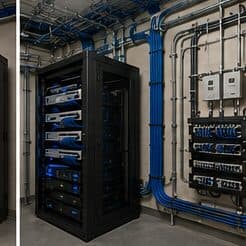
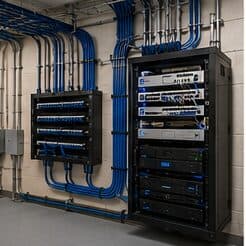
- Equipment room secured, since it holds the systems everything depends on
Dedicated plate capture, night handling, and reach to the gate
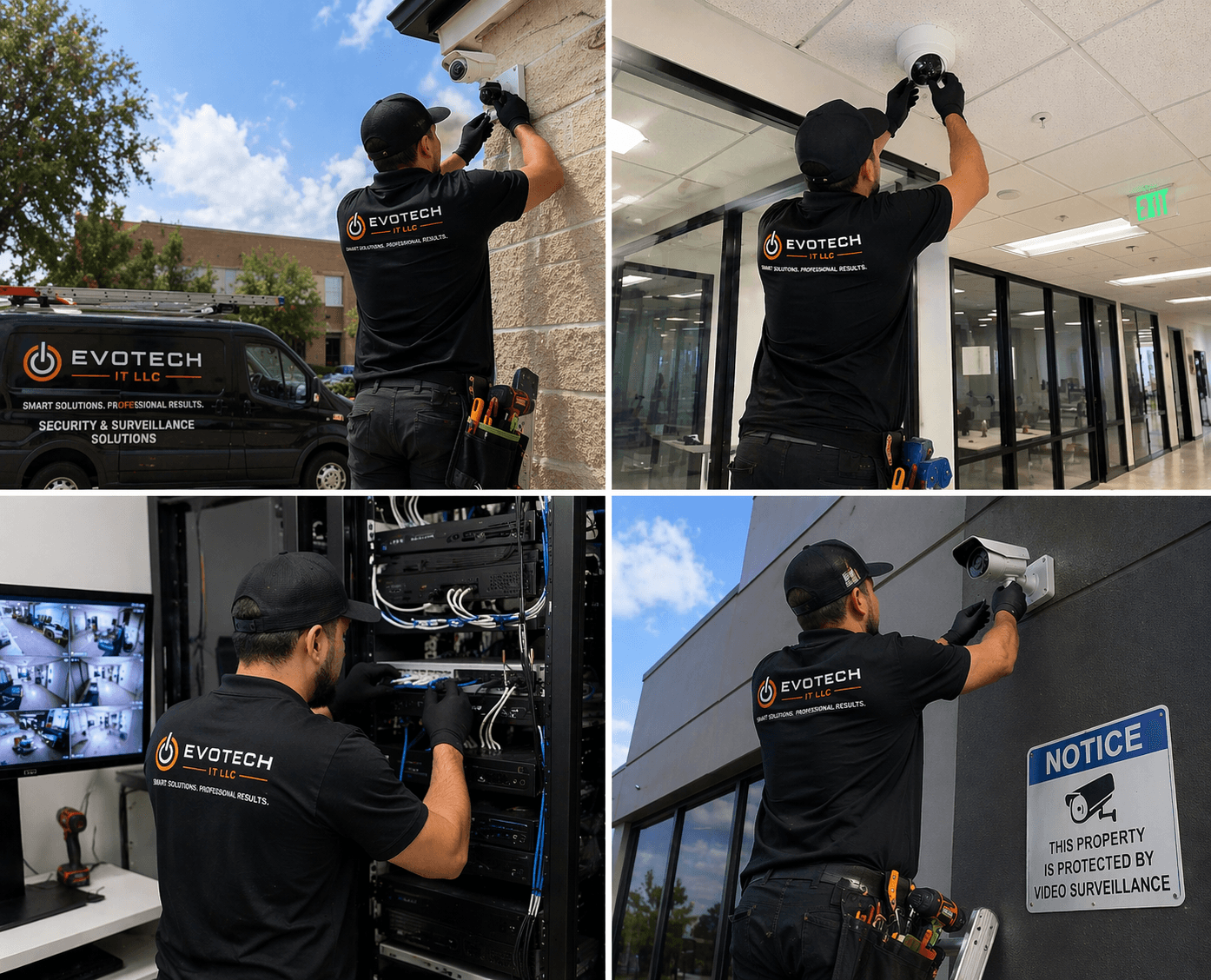
License-plate capture is a specialised camera task. It needs a fast shutter to freeze a plate on a moving vehicle, a narrow field of view and a shallow angle aimed at where plates present, and a distance matched to the lens so the plate fills enough of the frame to be legible. Because a plate is retroreflective, the infrared is controlled so the plate is lit to read rather than blown out — settings that make the plate legible also make the rest of the scene dark, which is exactly why a separate overview camera covers context.
- A dedicated plate camera: fast shutter, narrow view, shallow angle
- Distance and lens matched so the plate is legible in frame
- Controlled infrared so the reflective plate reads at night
- A separate overview camera for the scene and context
- Fiber or intermediate-powered runs to distant gate positions
- Mounting angle and height set for plate presentation
Frequently asked questions
What changes about gate & license-plate cameras in medical offices?
The operating environment does. Medical offices bring specific constraints — how the space is used, when work can happen, and what has to keep running — and those shape the gate & license-plate cameras plan as much as the service's own technical requirements.
Can one camera watch the gate and read plates?
Rarely well. Reading a plate needs a fast shutter, a narrow view, a shallow angle, and controlled infrared — settings that make the plate legible also make the wider scene dark. A general overview camera cannot resolve a plate on a moving vehicle. The reliable approach is two cameras: one for the scene, one dedicated to plates.
Should patient guest Wi-Fi be offered?
It is common in waiting areas, and the requirement is that it is architecturally isolated: unable to reach clinical systems, staff devices, or building systems, and rate-limited so it cannot affect anything operational. Configured that way it is a low-risk courtesy; configured as a shared flat network it is not.