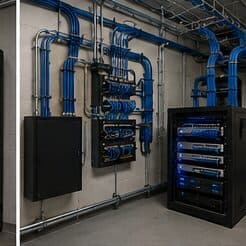
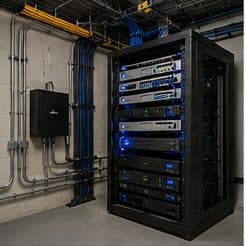
In-wall cable concealment for medical offices, in Fulshear
In-wall cable concealment for medical offices in Fulshear is a three-part question: what in-wall cable concealment involves, what medical offices need from it, and what Fulshear changes about the install. Predominantly recent residential construction, so prewire timing rather than retrofit access is the usual constraint.
The work itself is fishing cable through a finished wall, and how hard that is depends entirely on what is inside it. An open stud cavity is quick; fire blocking, insulation, a masonry or metal-stud wall, or a fireplace structure can stop a fish tape and change the approach. Where a clean in-wall path genuinely isn't available, a paintable surface raceway is the honest alternative.
Segmentation and clinical connectivity
Clinical systems belong on their own segment, separate from staff general-purpose devices, separate again from patient guest access, and separate from building systems such as cameras and door controllers. This limits what any single compromised device can reach and makes the network far easier to reason about when something misbehaves.
For clinical equipment that moves large files — imaging in particular — wired connections are worth insisting on where the equipment supports them. Wireless is fine for tablets and general staff use, but a modality pushing studies across a congested wireless cell produces exactly the kind of intermittent slowness that is difficult to diagnose and disruptive to a clinic day.
Guest access in a waiting area should be isolated from everything internal and rate-limited. It is a courtesy, and it should be architecturally incapable of touching anything clinical.
- Clinical, staff, guest, and building-system traffic on separate segments
- Wired connections for imaging and other high-throughput clinical equipment
- Waiting-area guest access isolated and capped
- Access points placed for coverage in treatment rooms without relying on corridor spill
- Equipment room secured, since it holds the systems everything depends on
What drives the cost of in-wall cable concealment here
Wall construction and the power solution drive the cost.
- Wall construction and cavity contents
- Recessed outlet or rated power-relocation kit
- Distance and number of cables
- Any access cuts and their patch-and-paint
- Surface raceway where no in-wall path exists
- Whether it is bundled with a TV or soundbar mount
Fulshear: what the location changes
What separates a Fulshear scope from the rest of the city is concrete and local. Predominantly recent residential construction, so prewire timing rather than retrofit access is the usual constraint. Large single-family floor plans requiring multiple wired coverage positions rather than a single router. Builder-provided media enclosures frequently undersized, unventilated, or awkwardly positioned for wireless coverage. That short list is what actually drives the design in this pocket, and it is why photographs or a brief site visit beat a floor plan — the plan follows the building's real constraints, not the neighborhood name on the map.
- Predominantly recent residential construction, so prewire timing rather than retrofit access is the usual constraint
- Large single-family floor plans requiring multiple wired coverage positions rather than a single router
- Builder-provided media enclosures frequently undersized, unventilated, or awkwardly positioned for wireless coverage
- Slab-on-grade foundations with accessible attics for post-construction additions
- Larger lots with detached garages and outbuildings needing their own deliberate connectivity approach
Getting it done in Fulshear
Concealment is judged by a clean result and a safe, code-compliant power path.
Work in treatment areas is scheduled around patient sessions, which typically means early mornings, evenings, or non-clinical days. Corridors and public areas are more flexible but still need containment and clean working practice.
Execution in Fulshear is planned around real conditions, not a template. Slab-on-grade foundations with accessible attics for post-construction additions. Larger lots with detached garages and outbuildings needing their own deliberate connectivity approach. These decide the sequence, the access, and the method as much as the design does. EVOTECH describes Fulshear as coverage rather than a place it occupies, and omits any area detail it cannot confirm — building and site conditions only, no invented landmarks or promised arrival times.
Frequently asked questions
Is in-wall cable concealment for medical offices different in Fulshear?
The sector needs stay the same, but the install changes with the place. In Fulshear, the conditions above — not the medical offices label — decide routes, mounting, and equipment placement, which is why this page pairs all three.
Can the power cord be hidden in the wall too?
Not the standard cord — running one inside a wall is against code and a genuine hazard. Power is concealed correctly with a recessed outlet behind the display or a rated in-wall power-relocation kit, which puts the outlet where the TV needs it without burying a cord. The signal cables can go in the wall; power is handled the right way.