Network troubleshooting for home offices, in Tomball
Network troubleshooting for home offices in Tomball is a three-part question: what network troubleshooting involves, what home offices need from it, and what Tomball changes about the install. A historic small-town core with masonry buildings and limited pathway.
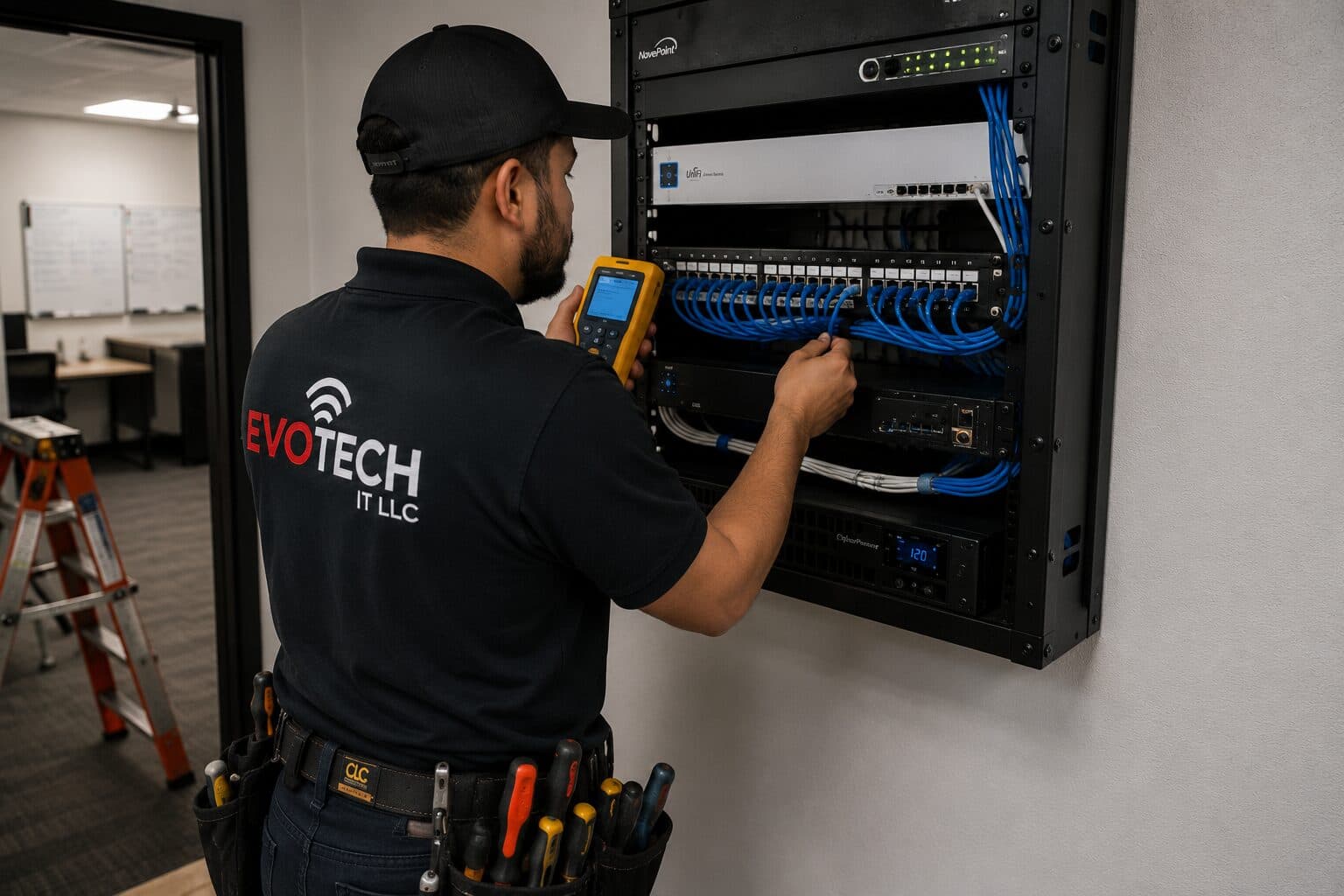
Effective troubleshooting is a process of elimination against a specific, reproducible symptom. 'The internet is slow' is not yet a diagnosis — slow for whom, on which devices, wired or wireless, at what times, to which destinations. Those answers usually point at a layer before any equipment is touched.
Working in an occupied house
Residential work happens in an occupied home, which means dust control, furniture protection, and leaving each area clean at the end of the day. Attic work in this region is constrained by heat and is generally scheduled early in the day during summer months.
Finish expectations are higher than in commercial work. A cable route that involves any drywall access needs a clear conversation about patching and paint before the first cut, not after.
- Dust control and furniture protection in occupied rooms
- Attic work scheduled early during summer months
- Drywall access, patching, and paint agreed before cutting
- Work sequenced so the household is not without connectivity overnight
- Equipment position agreed with the household, not just chosen for convenience
What drives the cost of network troubleshooting here
Diagnostic time is the cost, and documentation is the biggest thing that reduces it.
- Whether the network is documented and labeled
- Site size and number of areas involved
- How intermittent the symptom is
- Whether manageable switching provides statistics
- Amount of remediation required once the cause is identified
- Whether the work must happen outside operating hours
Tomball: what the location changes
A historic small-town core with masonry buildings and limited pathway. In Tomball, that is where the plan begins, because it changes cable paths, device placement, and access-point counts before anything else does. Growing retail and medical buildouts with suspended-grid ceilings and tenant-improvement conditions. Larger properties and outbuildings toward the northern edge, bringing longer runs. None of these are generic checklist items — each moves the design in a direction a citywide assumption would miss, and the honest recommendation always depends on what this particular property allows.
- A historic small-town core with masonry buildings and limited pathway
- Growing retail and medical buildouts with suspended-grid ceilings and tenant-improvement conditions
- Larger properties and outbuildings toward the northern edge, bringing longer runs
- Slab-foundation residential across established and newer subdivisions
- Gulf Coast humidity requiring rated exterior housings and sealed penetrations
Getting it done in Tomball
The test that matters is the one that reproduces the original complaint, run again after the change.
The single highest-value change for a home office is a wired connection to the desk. It removes wireless variability entirely for the machine that matters, and it is usually one cable run.
On site, the schedule and working method turn on conditions like these. Slab-foundation residential across established and newer subdivisions. Gulf Coast humidity requiring rated exterior housings and sealed penetrations. Both shape how and when a crew can actually operate, which is why EVOTECH scopes each Tomball job from the property itself rather than assuming one approach fits every address. Coverage is stated as a service area, never an office claim, and anything about Tomball that cannot be verified is left out instead of invented.
Frequently asked questions
Is network troubleshooting for home offices different in Tomball?
The sector needs stay the same, but the install changes with the place. In Tomball, the conditions above — not the home offices label — decide routes, mounting, and equipment placement, which is why this page pairs all three.
Why is the network slow only in the afternoon?
Time-correlated symptoms usually mean capacity rather than a fault. Something is consuming the shared resource at that time — backups, updates, more people on site, or a scheduled process. Measuring at the gateway during the slow period, and comparing it to a quiet period, distinguishes a saturated circuit from an internal bottleneck quickly.