Wireless bridge (point-to-point) for home offices, in Stafford
Wireless bridge (point-to-point) for home offices in Stafford is a three-part question: what wireless bridge (point-to-point) involves, what home offices need from it, and what Stafford changes about the install. Commercial base weighted toward warehouse, showroom, and light-industrial buildings rather than office space.
A point-to-point wireless bridge connects two buildings or locations across a distance where trenching fiber is impractical — a yard, a road, a parking lot between two structures. A pair of directional radios, aimed precisely at each other, carry the network link through the air. It is the right tool when a physical run is genuinely not feasible, and it depends almost entirely on one thing: a clear, unobstructed line of sight between the two points.
Related residential work
Home office projects frequently expand slightly, because the same attic access and the same equipment position serve other things. A doorbell run, a camera at the driveway approach, a wired connection to a television, and an access point for the upstairs are all much cheaper done in the same visit than separately.
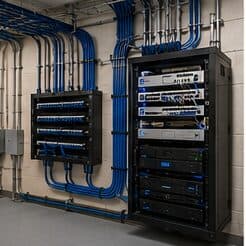
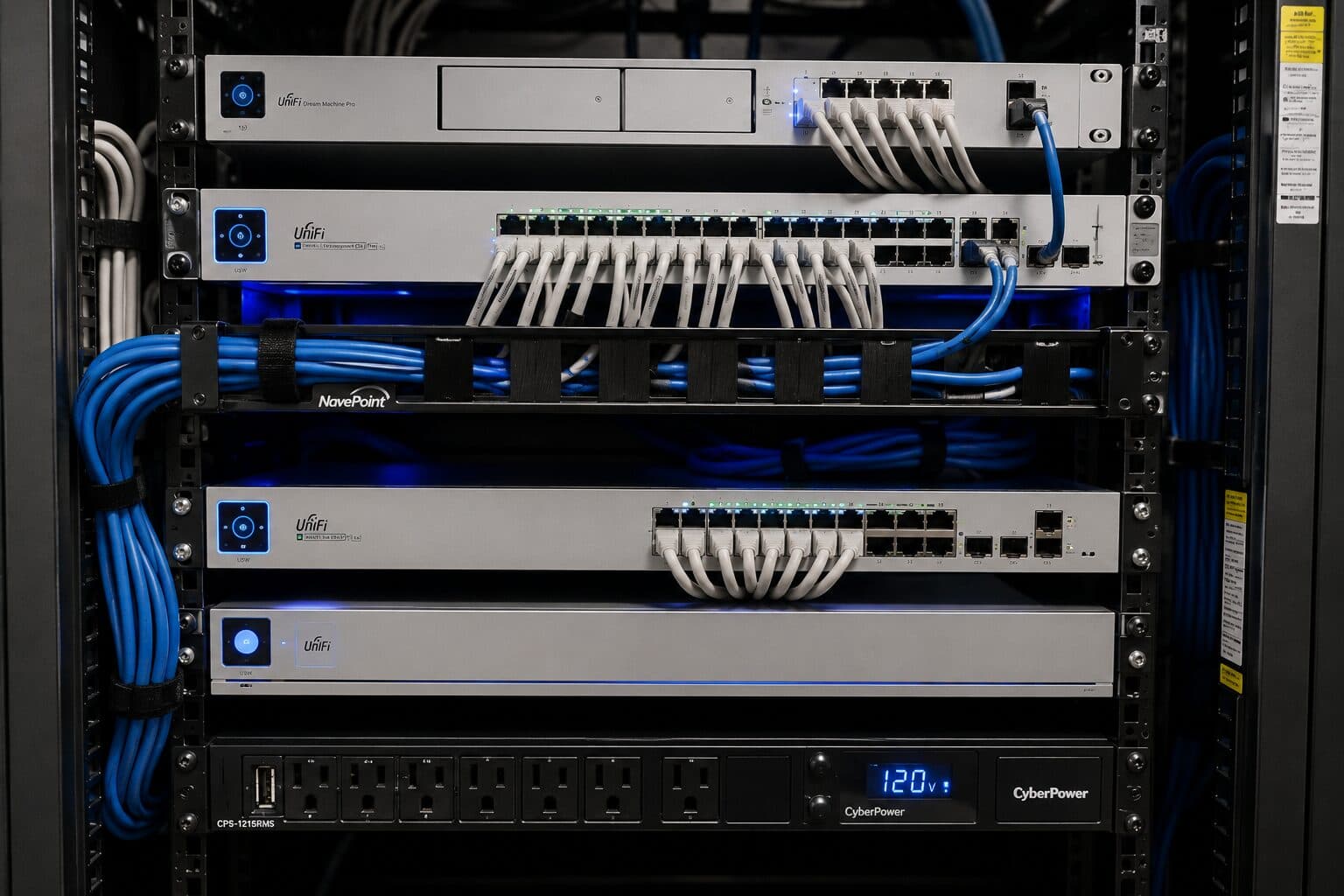
The equipment position is the common dependency. Somewhere with power, ventilation, and access — a closet shelf or a small wall cabinet — serves the office network, any cameras, and the doorbell, and getting it right once avoids revisiting it three times.
- Doorbell and driveway camera runs sharing the same attic access
- Television and media positions wired at the same time
- Upstairs access point added while the pathway is open
- A single equipment position serving all of it
- Spare runs terminated for future use
Where wireless bridge (point-to-point) goes wrong — and how it's avoided
Wireless bridges fail on the path and on expectations.
- Planning a link without confirming Fresnel-zone clearance
- Mounting too low, so ground and foliage intrude on the path
- Ignoring seasonal foliage that fills in and degrades the link
- Misaligning the narrow beams
- Promising wired speed regardless of distance and obstruction
- Choosing a congested band without checking interference
Stafford: what the location changes
Commercial base weighted toward warehouse, showroom, and light-industrial buildings rather than office space. In Stafford, that is where the plan begins, because it changes cable paths, device placement, and access-point counts before anything else does. Metal building construction that reflects wireless signal and changes coverage behaviour compared with drywall interiors. Building footprints frequently exceeding the 100 m copper channel limit from a single equipment position. None of these are generic checklist items — each moves the design in a direction a citywide assumption would miss, and the honest recommendation always depends on what this particular property allows.
- Commercial base weighted toward warehouse, showroom, and light-industrial buildings rather than office space
- Metal building construction that reflects wireless signal and changes coverage behaviour compared with drywall interiors
- Building footprints frequently exceeding the 100 m copper channel limit from a single equipment position
- Largely unconditioned operational areas where equipment placement has to account for summer temperatures and dust
- Mixed occupancy within single buildings, with small conditioned office areas attached to large operational space
Getting it done in Stafford
A bridge is commissioned on signal, throughput, and stability.
A home office shares its connection with everything else in the house, and household demand is highest during exactly the hours that matter least to the household and most to the person working. Streaming, gaming, backups, and connected devices all contend for the same circuit and, if the office is on wireless, for the same airtime.
On site, the schedule and working method turn on conditions like these. Largely unconditioned operational areas where equipment placement has to account for summer temperatures and dust. Mixed occupancy within single buildings, with small conditioned office areas attached to large operational space. Both shape how and when a crew can actually operate, which is why EVOTECH scopes each Stafford job from the property itself rather than assuming one approach fits every address. Coverage is stated as a service area, never an office claim, and anything about Stafford that cannot be verified is left out instead of invented.
Frequently asked questions
Is wireless bridge (point-to-point) for home offices different in Stafford?
The sector needs stay the same, but the install changes with the place. In Stafford, the conditions above — not the home offices label — decide routes, mounting, and equipment placement, which is why this page pairs all three.
When should I use a wireless bridge instead of running cable?
When a physical run is genuinely impractical — a road, a parking lot, or a distance that would mean major trenching between two buildings. Where a cable can reasonably go, especially fiber between separately grounded structures, it is more reliable. A bridge is the right tool specifically when the gap can't be crossed physically and there is clear line of sight.