In-wall cable concealment for home offices, in Stafford
In-wall cable concealment for home offices in Stafford is a three-part question: what in-wall cable concealment involves, what home offices need from it, and what Stafford changes about the install. Commercial base weighted toward warehouse, showroom, and light-industrial buildings rather than office space.
Concealing the cables behind a wall-mounted TV or AV setup is what turns it from a device with wires hanging down into something that looks built-in. The signal cables — HDMI, network, speaker — can be routed inside the wall to a recessed box behind the display, but power is different: a standard power cord must never be run inside a wall. Power is handled with a recessed outlet behind the display or an in-wall rated power solution, which keeps the installation safe and to code.
Related residential work
Home office projects frequently expand slightly, because the same attic access and the same equipment position serve other things. A doorbell run, a camera at the driveway approach, a wired connection to a television, and an access point for the upstairs are all much cheaper done in the same visit than separately.
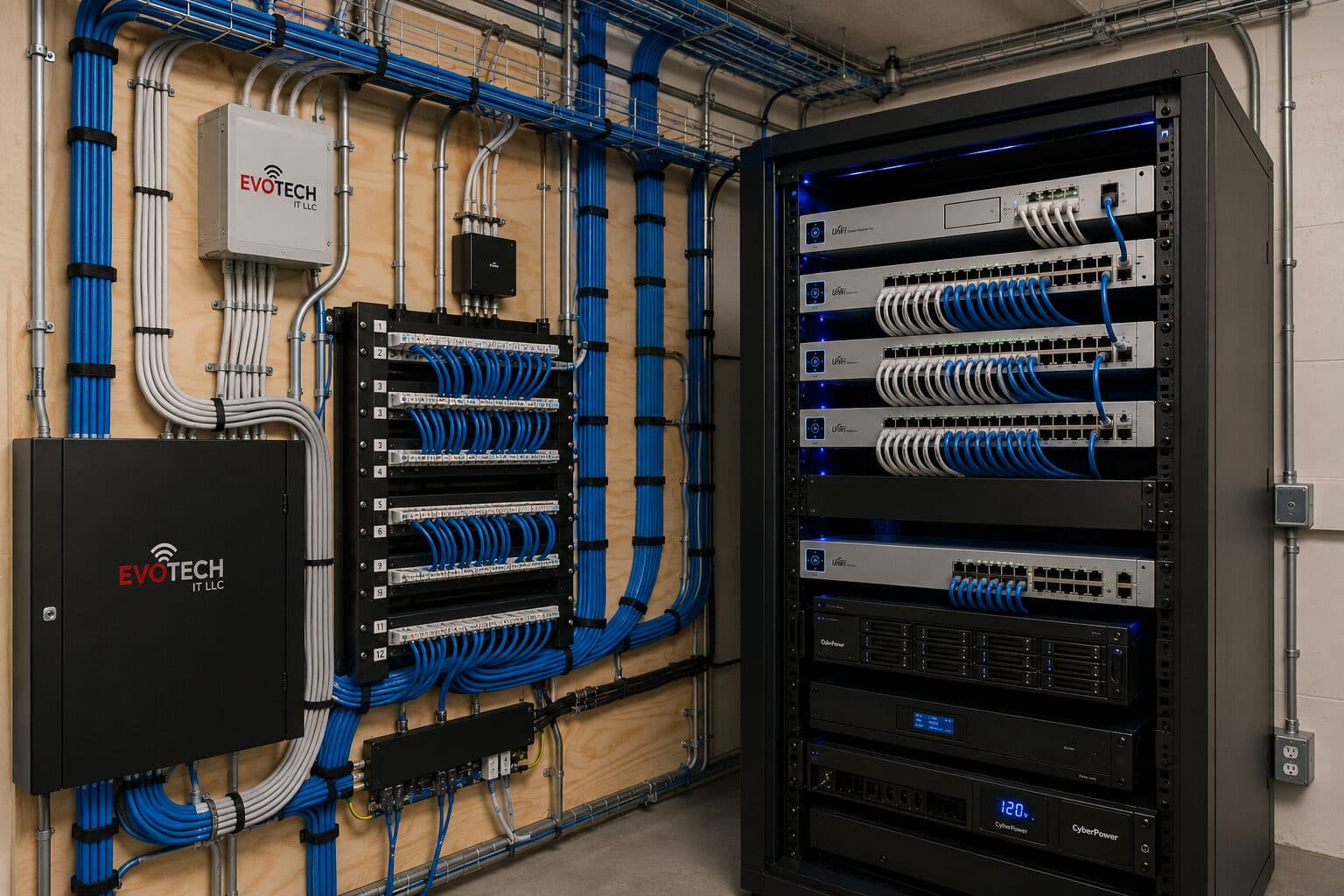
The equipment position is the common dependency. Somewhere with power, ventilation, and access — a closet shelf or a small wall cabinet — serves the office network, any cameras, and the doorbell, and getting it right once avoids revisiting it three times.
- Doorbell and driveway camera runs sharing the same attic access
- Television and media positions wired at the same time
- Upstairs access point added while the pathway is open
- A single equipment position serving all of it
- Spare runs terminated for future use
Where in-wall cable concealment goes wrong — and how it's avoided
Concealment goes wrong on power and on the wall's contents.
- Running a standard power cord inside the wall
- Forcing a fish tape past fire blocking and damaging the finish or wall
- Not planning patch-and-paint before cutting access
- Leaving no service loop for future work
- Assuming a clean path exists without checking the construction
- Compromising the wall's fire integrity to hide a cable
Stafford: what the location changes
In Stafford, the plan is built outward from the conditions that are actually here. Commercial base weighted toward warehouse, showroom, and light-industrial buildings rather than office space. Metal building construction that reflects wireless signal and changes coverage behaviour compared with drywall interiors. Building footprints frequently exceeding the 100 m copper channel limit from a single equipment position. Each one changes where cable can run, where equipment can sit, and how coverage is shaped, which is why a walkthrough settles a Stafford scope faster than any generic estimate.
- Commercial base weighted toward warehouse, showroom, and light-industrial buildings rather than office space
- Metal building construction that reflects wireless signal and changes coverage behaviour compared with drywall interiors
- Building footprints frequently exceeding the 100 m copper channel limit from a single equipment position
- Largely unconditioned operational areas where equipment placement has to account for summer temperatures and dust
- Mixed occupancy within single buildings, with small conditioned office areas attached to large operational space
Getting it done in Stafford
Concealment is judged by a clean result and a safe, code-compliant power path.
A home office shares its connection with everything else in the house, and household demand is highest during exactly the hours that matter least to the household and most to the person working. Streaming, gaming, backups, and connected devices all contend for the same circuit and, if the office is on wireless, for the same airtime.
Getting Stafford work done means planning around the site as it actually is. Largely unconditioned operational areas where equipment placement has to account for summer temperatures and dust. Mixed occupancy within single buildings, with small conditioned office areas attached to large operational space. Both matter as much as the design to how and when the work happens. The scope is drawn from the real property, the coverage is stated as a service area rather than an office, and unverifiable specifics about Stafford are kept off the page on purpose.
Frequently asked questions
Is in-wall cable concealment for home offices different in Stafford?
The sector needs stay the same, but the install changes with the place. In Stafford, the conditions above — not the home offices label — decide routes, mounting, and equipment placement, which is why this page pairs all three.
Can the power cord be hidden in the wall too?
Not the standard cord — running one inside a wall is against code and a genuine hazard. Power is concealed correctly with a recessed outlet behind the display or a rated in-wall power-relocation kit, which puts the outlet where the TV needs it without burying a cord. The signal cables can go in the wall; power is handled the right way.