Why this page exists
Technology for home offices in Spring Branch sits where two things meet: how home offices actually operate, and what Spring Branch specifically brings to the building. Spring Branch 77043 is a study in contrasts — original 1950s-1960s ranch homes on large lots sitting beside dense new townhome infill and light-commercial frontage.
A wired connection to the desk eliminates the variables that cause most home-office call problems: signal strength, interference from neighbouring networks, and contention with household devices for airtime. In slab-foundation construction the run typically goes up into the attic and down an interior wall, which is why the destination wall matters more than the distance.
The single cable that fixes most of it
A wired connection to the desk eliminates the variables that cause most home-office call problems: signal strength, interference from neighbouring networks, and contention with household devices for airtime. In slab-foundation construction the run typically goes up into the attic and down an interior wall, which is why the destination wall matters more than the distance.
Where the office must stay wireless, the fix is placement rather than power. An access point in the hallway near the office, mounted on the ceiling and connected by cable, serves the room far better than a more powerful router at the other end of the house. Turning up transmit power on a distant router mostly raises interference.
Separation is worth doing even at home. A separate network for work equipment, distinct from household devices and from guests, limits what a compromised household device can reach. This is straightforward on most current equipment and costs nothing but configuration.
- Wired run to the desk as the highest-value single change
- Access point placed near the office rather than more power from a distant router
- Attic-to-interior-wall routing in slab-foundation homes
- Separate network segment for work equipment
- Stationary household devices wired to free up airtime
Spring Branch: what the location adds
Spring Branch 77043 is a study in contrasts — original 1950s-1960s ranch homes on large lots sitting beside dense new townhome infill and light-commercial frontage. In Spring Branch, that is where the plan begins, because it changes cable paths, device placement, and access-point counts before anything else does. The mid-century ranch stock is slab with accessible attics, while the new townhomes are tight three-story vertical builds. Deep original lots leave room for detached structures and long driveway runs that lengthen camera and gate wiring. None of these are generic checklist items — each moves the design in a direction a citywide assumption would miss, and the honest recommendation always depends on what this particular property allows.
- Spring Branch 77043 is a study in contrasts — original 1950s-1960s ranch homes on large lots sitting beside dense new townhome infill and light-commercial frontage
- The mid-century ranch stock is slab with accessible attics, while the new townhomes are tight three-story vertical builds
- Deep original lots leave room for detached structures and long driveway runs that lengthen camera and gate wiring
- Commercial frontage along the major roads brings small-business network and camera work adjacent to the residential streets
- Teardown-rebuild activity means modern prewire and untouched original wiring coexist block by block
Related residential work
Home office projects frequently expand slightly, because the same attic access and the same equipment position serve other things. A doorbell run, a camera at the driveway approach, a wired connection to a television, and an access point for the upstairs are all much cheaper done in the same visit than separately.
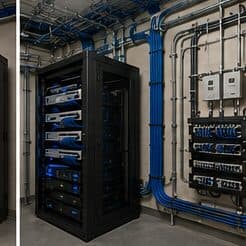
The equipment position is the common dependency. Somewhere with power, ventilation, and access — a closet shelf or a small wall cabinet — serves the office network, any cameras, and the doorbell, and getting it right once avoids revisiting it three times.
- Doorbell and driveway camera runs sharing the same attic access
- Television and media positions wired at the same time
- Upstairs access point added while the pathway is open
- A single equipment position serving all of it
- Spare runs terminated for future use
Installing in Spring Branch
Residential work happens in an occupied home, which means dust control, furniture protection, and leaving each area clean at the end of the day. Attic work in this region is constrained by heat and is generally scheduled early in the day during summer months.
On site, the schedule and working method turn on conditions like these. Commercial frontage along the major roads brings small-business network and camera work adjacent to the residential streets. Teardown-rebuild activity means modern prewire and untouched original wiring coexist block by block. Both shape how and when a crew can actually operate, which is why EVOTECH scopes each Spring Branch job from the property itself rather than assuming one approach fits every address. Coverage is stated as a service area, never an office claim, and anything about Spring Branch that cannot be verified is left out instead of invented.
Popular services nearby
Frequently searched near this area — the pages people look for most.
Frequently asked questions
What do home offices in Spring Branch usually need first?
It varies by site, but the pattern for home offices holds in Spring Branch: get the network and cabling backbone right, then layer cameras and access on top. What Spring Branch changes is the physical install — the conditions listed above drive routes and equipment placement more than the sector alone does.
Why do work calls degrade in the afternoon?
Usually contention. Household demand rises when people are home, and if the office is on wireless it competes both for the internet circuit and for airtime on the same radio channel. A wired connection to the desk removes the airtime half of that immediately, which is why it is the first thing worth doing.