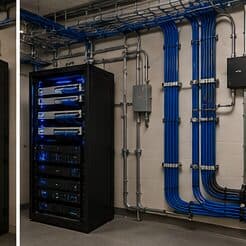
Ethernet installation for churches, in Tomball
Ethernet installation for churches in Tomball is a three-part question: what ethernet installation involves, what churches need from it, and what Tomball changes about the install. A historic small-town core with masonry buildings and limited pathway.
The wired connection itself is worth the effort for specific reasons: desktops and consoles that never have to compete for airtime, ceiling access points fed by cable rather than repeating a wireless signal, cameras and doorbells powered over the same run, and a television that streams without depending on Wi-Fi conditions.
Access control and modest camera coverage
Church buildings are used by many people at many different times, which makes key management genuinely burdensome and access control genuinely useful. Credential access with schedules — different groups having access to different areas at different times — solves a problem that physical keys solve badly.
Camera coverage is usually focused on entrances, children's-ministry areas' approaches, offices, parking areas, and equipment storage. As in clinical settings, the boundary matters: worship spaces and children's classrooms are not general camera locations, and agreeing that explicitly during design prevents awkward conversations later.
- Credential access with per-group schedules replacing widely copied keys
- Entrance, office, and equipment storage coverage
- Parking area coverage for evening and weekend use
- Children's area approaches rather than interiors
- Access records that show who entered outside normal hours
Where ethernet installation goes wrong — and how it's avoided
Retrofit mistakes are usually decided at the planning stage, not the pull.
- Choosing an equipment position with no power or no ventilation
- Running a single cable to a location that will obviously need two
- Terminating in a wall plate with no slack, leaving no room to re-terminate
- Routing cable across recessed lighting fixtures in the attic
- Skipping labeling because the run count is small — the same tracing cost applies later
Tomball: what the location changes
What separates a Tomball scope from the rest of the city is concrete and local. A historic small-town core with masonry buildings and limited pathway. Growing retail and medical buildouts with suspended-grid ceilings and tenant-improvement conditions. Larger properties and outbuildings toward the northern edge, bringing longer runs. That short list is what actually drives the design in this pocket, and it is why photographs or a brief site visit beat a floor plan — the plan follows the building's real constraints, not the neighborhood name on the map.
- A historic small-town core with masonry buildings and limited pathway
- Growing retail and medical buildouts with suspended-grid ceilings and tenant-improvement conditions
- Larger properties and outbuildings toward the northern edge, bringing longer runs
- Slab-foundation residential across established and newer subdivisions
- Gulf Coast humidity requiring rated exterior housings and sealed penetrations
Getting it done in Tomball
Every run gets a wire-map and length check at minimum, which catches the errors that actually happen in retrofit work: a reversed pair at a hastily terminated jack, a split pair, or a run longer than it looked.
The defining constraint in church technology is who operates it. Systems are typically run by volunteers who rotate, may have limited technical background, and are operating live in front of a congregation. A system that requires specialist knowledge to start is a system that will fail publicly.
Getting Tomball work done means planning around the site as it actually is. Slab-foundation residential across established and newer subdivisions. Gulf Coast humidity requiring rated exterior housings and sealed penetrations. Both matter as much as the design to how and when the work happens. The scope is drawn from the real property, the coverage is stated as a service area rather than an office, and unverifiable specifics about Tomball are kept off the page on purpose.
Popular services nearby
Frequently searched near this area — the pages people look for most.
Frequently asked questions
Is ethernet installation for churches different in Tomball?
The sector needs stay the same, but the install changes with the place. In Tomball, the conditions above — not the churches label — decide routes, mounting, and equipment placement, which is why this page pairs all three.
Can Ethernet be added without cutting into walls?
Often yes, when the destination is an interior wall reachable from an attic or crawl space and there is no blocking in the cavity. When there is no viable cavity path, the choices are a small access cut that then gets patched, a surface raceway, or moving the device to a wall that can be reached. Which one makes sense is worth deciding before work starts rather than mid-pull.