Data-jack installation for churches, in Sugar Land
Data-jack installation for churches in Sugar Land is a three-part question: what data-jack installation involves, what churches need from it, and what Sugar Land changes about the install. Commercial base weighted toward professional offices and medical suites rather than industrial space.
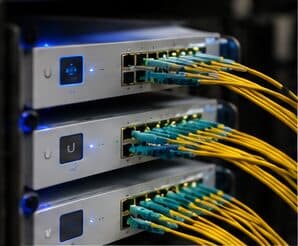
Most data-jack work is one of three things: adding new outlets to existing runs that were left coiled in a wall, replacing damaged or worn jacks, or re-terminating outlets that fail a test. The third is the most common on inherited buildings.
Access control and modest camera coverage
Church buildings are used by many people at many different times, which makes key management genuinely burdensome and access control genuinely useful. Credential access with schedules — different groups having access to different areas at different times — solves a problem that physical keys solve badly.
Camera coverage is usually focused on entrances, children's-ministry areas' approaches, offices, parking areas, and equipment storage. As in clinical settings, the boundary matters: worship spaces and children's classrooms are not general camera locations, and agreeing that explicitly during design prevents awkward conversations later.
- Credential access with per-group schedules replacing widely copied keys
- Entrance, office, and equipment storage coverage
- Parking area coverage for evening and weekend use
- Children's area approaches rather than interiors
- Access records that show who entered outside normal hours
What drives the cost of data-jack installation here
Jack work prices mostly on count and access.
- Number of outlets and ports per outlet
- Whether existing cable is present and usable
- Bracket or box installation in finished walls
- Component grade and whether shielding is required
- Testing and documentation requested
Sugar Land: what the location changes
The starting point for any Sugar Land job is one local fact. Commercial base weighted toward professional offices and medical suites rather than industrial space. That single condition shapes where cable can run, where equipment can sit, and how coverage is laid out — more than any spec sheet does. Two more conditions weigh on it. Multi-tenant buildings where base-building rules govern riser access, core penetrations, and after-hours work. Suspended-grid ceilings common in office suites, with hard-lid areas in reception and clinical spaces. Together they make the route specific to this pocket, which is why a short walkthrough or a few clear photos settle the scope faster than a floor plan can.
- Commercial base weighted toward professional offices and medical suites rather than industrial space
- Multi-tenant buildings where base-building rules govern riser access, core penetrations, and after-hours work
- Suspended-grid ceilings common in office suites, with hard-lid areas in reception and clinical spaces
- Retail centres with storefront glazing that complicates entrance camera placement due to daylight backlighting
- Master-planned commercial development producing comparatively consistent, newer construction
Getting it done in Sugar Land
A jack is only finished when the link tests clean. Wire map catches scheme errors and split pairs; a full certification confirms the termination preserved enough margin for the rated category.
The defining constraint in church technology is who operates it. Systems are typically run by volunteers who rotate, may have limited technical background, and are operating live in front of a congregation. A system that requires specialist knowledge to start is a system that will fail publicly.
Getting Sugar Land work done means planning around the site as it actually is. Retail centres with storefront glazing that complicates entrance camera placement due to daylight backlighting. Master-planned commercial development producing comparatively consistent, newer construction. Both matter as much as the design to how and when the work happens. The scope is drawn from the real property, the coverage is stated as a service area rather than an office, and unverifiable specifics about Sugar Land are kept off the page on purpose.
Popular services nearby
Frequently searched near this area — the pages people look for most.
Frequently asked questions
Is data-jack installation for churches different in Sugar Land?
The sector needs stay the same, but the install changes with the place. In Sugar Land, the conditions above — not the churches label — decide routes, mounting, and equipment placement, which is why this page pairs all three.
Why did a link start failing after a jack was replaced?
Usually untwist or category mismatch. If more pair was untwisted at the punch-down than the standard allows, crosstalk performance drops, and a link that previously passed with small margin can fail. If the replacement jack is a lower category than the cable, the whole channel is capped at the lower rating. Both show up immediately in a certification test.