Network-rack installation for churches, in Missouri City
Network-rack installation for churches in Missouri City is a three-part question: what network-rack installation involves, what churches need from it, and what Missouri City changes about the install. Housing stock spanning both established and recent construction, producing materially different retrofit conditions between neighbourhoods.
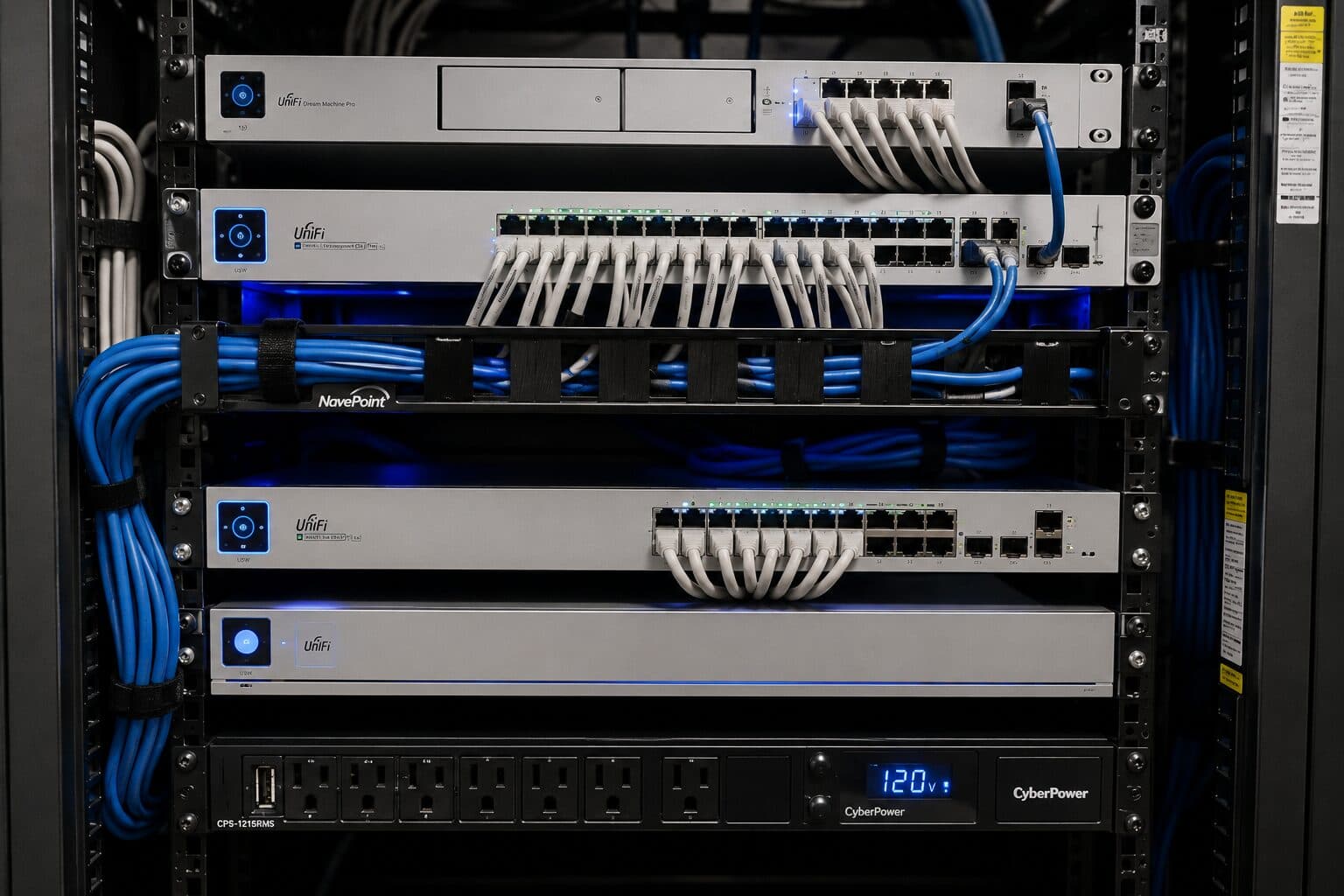
Rack sizing is measured in rack units — each U is 1.75 inches of vertical mounting space. Counting the equipment gives a starting number, but the useful sizing rule is to add space for cable management between device groups and leave roughly a third of the rack empty for whatever arrives later. A rack packed to capacity on day one is a rack that gets a switch balanced on top of it within a year.
Access control and modest camera coverage
Church buildings are used by many people at many different times, which makes key management genuinely burdensome and access control genuinely useful. Credential access with schedules — different groups having access to different areas at different times — solves a problem that physical keys solve badly.
Camera coverage is usually focused on entrances, children's-ministry areas' approaches, offices, parking areas, and equipment storage. As in clinical settings, the boundary matters: worship spaces and children's classrooms are not general camera locations, and agreeing that explicitly during design prevents awkward conversations later.
- Credential access with per-group schedules replacing widely copied keys
- Entrance, office, and equipment storage coverage
- Parking area coverage for evening and weekend use
- Children's area approaches rather than interiors
- Access records that show who entered outside normal hours
What changes network-rack installation from job to job
Rack scope moves with location constraints more than with equipment count.
- Total U required including management and growth allowance
- Wall-mount cabinet versus floor-standing rack, and depth required
- Location ventilation and ambient temperature
- Structural mounting requirements for the loaded weight
- Power availability and whether a dedicated circuit is needed
- UPS capacity and its weight and heat contribution
- Whether existing cabling must be re-dressed and re-terminated into new panels
- Access clearance in front of and behind the rack
Missouri City: what the location changes
Housing stock spanning both established and recent construction, producing materially different retrofit conditions between neighbourhoods. In Missouri City, that is where the plan begins, because it changes cable paths, device placement, and access-point counts before anything else does. Older homes without structured cabling and with less accessible attic space than newer subdivisions. Newer subdivision homes following the regional pattern of builder panels and good attic access. None of these are generic checklist items — each moves the design in a direction a citywide assumption would miss, and the honest recommendation always depends on what this particular property allows.
- Housing stock spanning both established and recent construction, producing materially different retrofit conditions between neighbourhoods
- Older homes without structured cabling and with less accessible attic space than newer subdivisions
- Newer subdivision homes following the regional pattern of builder panels and good attic access
- Small office and retail suites where ceiling construction and lease terms are the main variables
- Slab-on-grade construction throughout, keeping attic routing as the primary retrofit path
Getting it done in Missouri City
A rack is commissioned by checking it under load, not by looking at it when everything is idle.
The defining constraint in church technology is who operates it. Systems are typically run by volunteers who rotate, may have limited technical background, and are operating live in front of a congregation. A system that requires specialist knowledge to start is a system that will fail publicly.
On site, the schedule and working method turn on conditions like these. Small office and retail suites where ceiling construction and lease terms are the main variables. Slab-on-grade construction throughout, keeping attic routing as the primary retrofit path. Both shape how and when a crew can actually operate, which is why EVOTECH scopes each Missouri City job from the property itself rather than assuming one approach fits every address. Coverage is stated as a service area, never an office claim, and anything about Missouri City that cannot be verified is left out instead of invented.
Popular services nearby
Frequently searched near this area — the pages people look for most.
Frequently asked questions
Is network-rack installation for churches different in Missouri City?
The sector needs stay the same, but the install changes with the place. In Missouri City, the conditions above — not the churches label — decide routes, mounting, and equipment placement, which is why this page pairs all three.
What size rack is needed?
Add the U heights of every intended device, add a U of management between logical groups, add the patch panels, then add roughly a third for growth. The result is usually a size or two larger than the first instinct, and the extra space costs far less than the disruption of replacing an undersized cabinet later.